Three definitions of transgender

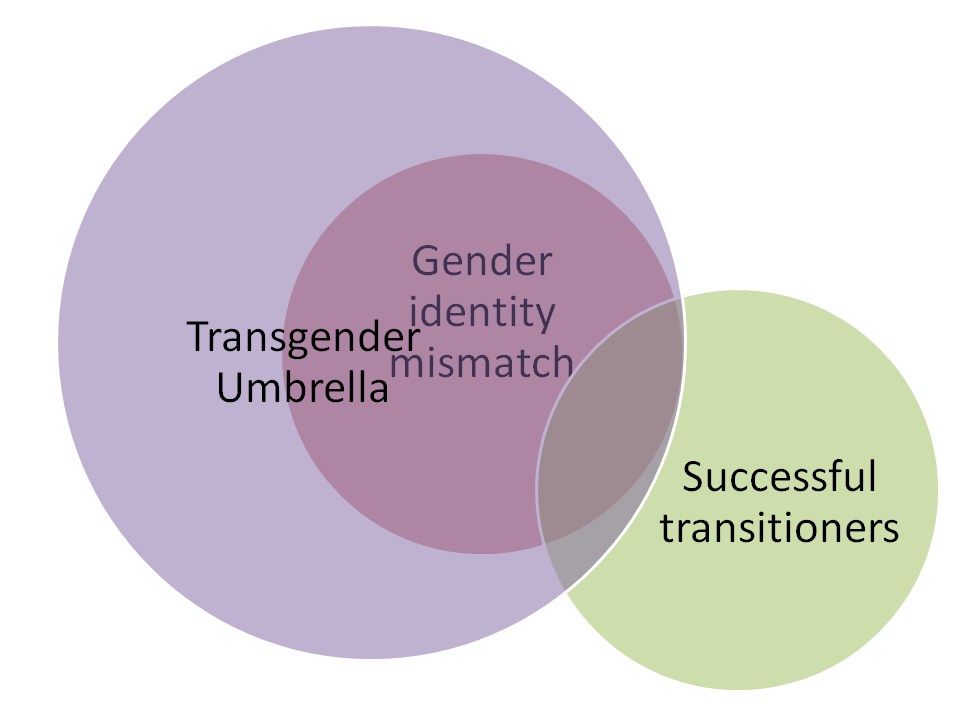
You may think you know what “transgender” means. But if you’ve been around the trans community for any length of time, you know that the word has been fought over before. There are at least three different ways that the word is used, and all apply to a somewhat different group of people.

First let’s take a look at one of the most widely circulated definitions, found in the GLAAD Media Reference Guide:

Transgender is an umbrella term for people whose gender identity and/or gender expression differs from the sex they were assigned at birth. The term may include, but is not limited to transsexuals, cross-dressers and other gender non-conforming people.

This is the famous “transgender umbrella” that we see in promotional materials and statistics. Note the “gender identity and/or expression” part – that’s the inclusive, welcoming part.

Now there’s another definition of “transgender” that conflicts with it. The funny thing is that it’s on the exact same page of GLAAD’s media guide, in the definition of “gender identity”:

Gender identity is one’s internal, personal sense of their gender. For transgender people, their birth-assigned gender and their own internal sense of gender identity are not the same.

In this definition, note that for transgender people – all of them – the assigned gender and gender identity are not the same. Those are the exclusionary, rejecting parts.

These two definitions contradict each other. The first one includes people whose gender identity doesn’t differ from our assigned gender, while the second one does not. They don’t both belong in the same organization, let alone on the same page.

There’s a third one, which was noted by Lal Zimman in his 2009 paper (PDF, page 58):

my use of the term transgender is not intended in the ‘umbrella label’ sense often found in literature dealing with issues of gender and sexuality. Nor is it intended as a pancultural descriptor to be applied to any gender variant community. Rather, my usage mirrors the meaning this term has taken on in many English-speaking transgender communities in the United States, in which it can serve as a demedicalized substitute for the term transsexual.

The GLAAD media guide notes that many people are substituting the term “transgender” for “transsexual,” and that not everyone is comfortable with that: “Unlike transgender, transsexual is not an umbrella term, as many transgender people do not identify as transsexual.” But then they give up on defining transsexual beyond that. Zimman provides a definition: “those individuals whose sense of themselves as men or women runs contrary to the gender they were assigned at birth, and who have therefore decided to make a social transition from one gender role to another (regardless of what medical interventions, if any, are pursued).”

I want to modify Zimman’s definition here, because he is mixing something that is observable (a gender role transition) with something that is not observable (a gender identity mismatch). His “therefore,” although it is widely claimed by many, is also unjustified. There are a significant number of people who transition to a new gender and report having no clear feeling of a gender identity mismatch (or even a gender identity at all) before transition; Zinnia Jones is probably the best known: “For most of my childhood, I didn’t feel like I had a meaningful identity of any kind, gender or otherwise.”

This leaves us with three definitions of “transgender”: the umbrella, the gender identity mismatch, and the transitioner. There is a lot more overlap among these definitions than the diagram above would suggest, but it remains true that there are people who fit under the umbrella who do not transition or have a gender identity mismatch. There are people who have a gender identity mismatch and fit under the umbrella who do not transition. And there are people who transition but do not have a gender identity mismatch or fit under the umbrella.

This is important to me as someone who fits under the umbrella but is not planning to transition. I hope that GLAAD will revise its Media Reference Guide to be more consistent with its stated goals of inclusion.

Good research of the month: “coming out” in trans communities

As you could probably tell, I feel bad describing research like the Trans Mental Health Study in such strong negative terms. I know that the authors wanted to do something to help the trans community, and they thought that was what they were doing. I want to balance that out by highlighting examples of transgender research done right.

I recently had the pleasure of meeting Lal Zimman, a fellow linguist who studies transgender language. In 2009, Zimman published a paper (PDF) summarizing his research into the concept of “coming out” in transgender communities.

A.C. Liang (1997) and Kathleen Wood (1997) reported on “coming out” stories of gay men and lesbians. In these stories, the term “coming out” is used to refer to the sharing of a sexual orientation. Because this orientation may not be visible, Zimman says, “Liang argues that reference to the ‘processual’ nature of coming out – in other words, the fact that coming out is not a single event but is rather reenacted time and again throughout an individual’s lifetime – is a crucial component of the coming out narrative.”

Zimman interviewed nine individuals who had completed a gender transition and found a pattern that will probably be familiar to a lot of you. They used “coming out” to share a transgender identity, but in one of two specific ways that were very different from those reported for gay men and lesbians. Those who hadn’t transitioned to their target gender used “coming out” to mean a declaration (in Zimman’s terms) of their desire or plans to transition to a different gender. Those who had transitioned used “coming out” to mean a disclosure of their history of gender transition.

This is the right way to do research on an unrepresentative sample. Ask relatively open-ended questions and listen to the answers. Note common threads among the answers. Use the stories to make existential arguments – ones that highlight the existence of something that may not have been acknowledged by the academic community. This is particularly valuable to show exceptions to generalizations that others have made. In this case, Zimman identifies exceptions to the generalizations that Liang and Wood made about coming out narratives.

Even though I think Zimman’s research is exemplary here, I want to note that I have a verbal hygiene argument with what he found. I don’t like these uses of the term “coming out,” and I think they’re bad for both the trans community and the wider LGBT community. But that’s a topic for another post. In the meantime, keep studying trans communities!

Bad stat of the month: Trans regret

I don’t want to do this. I want to be a happy trans. I don’t like being negative, and I don’t like singling out people. I’ve held back for years. Unfortunately, people keep putting in hours, months, years of work producing these bad statistics, and then advocating questionable policies based on them. This latest one could be really damaging. It’s about trans regret, and it comes from a British grad student named Maeve Regan:

The recent Trans Mental Health Study was the largest study of its kind ever undertaken in Europe, with almost 900 respondents. The study asked specifically about individuals’ feelings of regret following social and/or medical transition. These are the results:

In terms of social changes made during transition (coming out to friends and family, changing name, living full or part time in a gender not assigned at birth), 34% of respondents had minimal regrets and 9% had significant regrets. A small majority, 53% had no regrets.

Specific regrets given included: not having the body they had wanted from birth, not transitioning earlier, losing friends and family, and the impact of transition on others.

In terms of physical changes made during transition (resulting from hormone therapy and surgical interventions), the vast majority, 86%, had no regrets. Of the remainder, 10% had minor regrets and 2% had major regrets.

The specific regrets given include complications relating to surgery (especially loss of sensitivity), and the choice of surgeon (if surgery resulted in complications or required revisions and repairs).

Regan, who identifies herself as “cisgendered (not trans),” wrote the above as part of a summary of findings of the Trans Mental Health Study, for which she was “part of the Advisory Board.” [Edited to add]: She concludes, “It is clear from the actual reported regrets, along with the conclusions that transition is associated with a broad range of positive indicators, that most cases of regret around transition are not related to being a different gender to the one assigned at birth, or undergoing transition, but rather due to poor surgical outcomes, social stigma and huge barriers to medical care.”

In other words, trans people never regret transitioning. We only regret the way we’re treated, or the way the surgery turns out.

This statistic was used in an online discussion where I brought up trans regret. [Edited]: One of Regan’s co-authors, Jay McNeil, wrote, “we found that where people did have regrets, they were largely related to their experiences of how they were treated rather than the choices they’d made around their bodies. Where people felt like de-transitioning it was mainly because they lacked support to cope wit the social stigma and losses.”

How are these percentages bad statistics? They are taken from a non-representative sample and generalized to all transgender people in the United Kingdom. Specifically, this survey was collected using the ubiquitous “snowball” method:

Participants were encouraged to take part mainly through a process of snowballing. Trans support groups, online forums and mailing lists with UK members were contacted and given information about the study and asked to share the survey as widely as possible. Other equality and health groups, and professional networks with potential links to the trans population (e.g. LGBT networks; professionals whose work might bring them into contact with trans people) were also contacted and asked to distribute information about the survey. The survey spread primarily through word-of-mouth, and the researchers attended a number of trans groups in person to discuss the project and encourage participation. The survey was open for approximately 3 months (mid-April 2012 to mid-July 2012), during which time reminders were posted online, and the survey continued to be publicised.

The problem is that “trans people” are typically defined by whether they intend to transition. Regretters by definition withdraw that intent to transition, and are thus considered by many to be “not really trans.” Some regretters, like non-transitioners, accept that classification and affirm, “I guess I wasn’t trans after all.” Others may still consider themselves trans, but not want to hang around with the happy transitioning crowd. Would you?

Regretters who don’t believe they’re trans wouldn’t take a “trans mental health survey.” Regretters who are alienated from “the trans community” might not know about such a survey, and might not want to fill one out if they did know about it. So this survey is highly unlikely to have received responses from any serious regretters. That’s not evidence that regretters don’t exist, it’s evidence of bad sampling.

These numbers could be really damaging because they give a false impression that regret doesn’t exist. That could set up any number of trans people for serious disappointment down the road. Of course, with this “no true Scotsman” (ahem) reasoning, the authors may never find out.

As I said, this snowball method is all over the place. I don’t want to single out the authors of this study for doing what practically every other trans researcher is doing. I felt bad for focusing on Emilia Dunham for publishing a bunch of unfounded generalizations back in 2011. But you need to start somewhere. And the conclusions that Regan draws are bad, bad, bad.

I get the feeling that Regan and the other authors of the Trans Mental Health study are kind, caring people, and want to help all trans people. I think if they looked into the eyes of a regretter and saw the disappointment and frustration that I’ve seen, they would care about them too, and stop this denial. I wonder if they will ever allow themselves to do it.

“Gender identity” in the Violence Against Women Act

Recently, I got some messages asking me to press for transgender and lesbian, gay and bisexual inclusion in the Violence Against Women Act, a law that sunsets regularly but has just been reauthorized by Congress. The action alerts also talked about “gender identity,” and the definition that came to mind is this one from GLAAD, which is echoed in other definitions around the country: “One’s internal, personal sense of being a man or a woman (or a boy or a girl).”

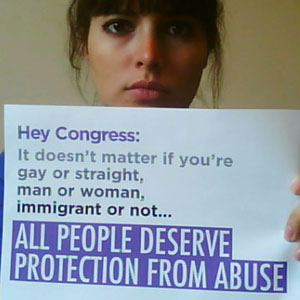
Photo: UltraViolet.org
I was concerned about the use of “gender identity” in this bill. Being white and middle-class I’m at relatively low risk, but there are other trans people from all ethnic and economic backgrounds who occasionally go out in public presenting as women, with male bodies unmodified by hormone or surgical treatment, and without a strong belief that we are women. We may be seen by others as women, as trans people or as gay men. We may be targeted for sexual assault, stalking or other violent actions based on those perceptions. A law that is based on the “internal sense” definition of gender identity would fail to protect us.

Today I took a closer look and discovered that this fight actually is relevant to people like me. The Violence Against Women Act, originally passed in 1994, provided grants for nonprofits and government agencies to run programs aimed at preventing violence against women and providing support for women who are victims of domestic and sexual violence.

The expanded version of the law passed by the Senate last year, but rejected by the House of Representatives, and then passed this week by both houses of Congress, includes new protections that weren’t in the original bill. Overall, it includes “dating violence” and “stalking” as eligible categories of violence in addition to “domestic violence” and “sexual assault.” It also includes provisions for “men, women, and youth in correctional and detention settings.”

One part that relates to transgender and LGB victims is the definition of “underserved populations.” There are grants for organizations working with underserved populations.

UNDERSERVED POPULATIONS.—The term “underserved populations” means populations who face barriers in accessing and using victim services, and includes populations underserved because of geographic location, religion, sexual orientation, gender identity, underserved racial and ethnic populations, populations underserved because of special needs (such as language barriers, disabilities, alienage status, or age), and any other population determined to be underserved by the Attorney General or by the Secretary of Health and Human Services, as appropriate.

Another section expands the Omnibus Crime Control and Safe Streets Act of 1968 to include support for the following:

developing, enlarging, or strengthening programs and projects to provide services and responses targeting male and female victims of domestic violence, dating violence, sexual assault, or stalking, whose ability to access traditional services and responses is affected by their sexual orientation or gender identity, as defined in section 249(c) of title 4 18, United States Code

In section 249(c) of the hate crimes law is where we actually get a legal definition of “gender identity,” and it turns out to be very different from that given by organizations like GLAAD:

the term ‘gender identity’ means actual or perceived gender-related characteristics

This definition is much broader than the “internal sense” definitions, but does a better job of delineating the class of victims who are underserved, and who are often actually denied services when people perceive them as “queers” or “trannies,” with no knowledge of their internal sense of gender.

The people who refuse to investigate or prosecute crimes against transgender people don’t give a rat’s ass what internal, personal sense of gender those transgender people have. If I (or someone like me who’s black or Mexican) get bashed and a cop won’t write it up, telling the cop that I really don’t have an internal, personal sense that I’m a woman isn’t going to get me any better treatment. That’s probably why the definition in the hate crimes law didn’t reference a sense of gender, and why this expanded Violence Against Women Act doesn’t either.

A final note: in the spirit of the Delhi protesters who said “Don’t tell your daughters to stay at home, instead teach your sons to behave,” I like this program in the new Violence Against Women Act:

ENGAGING MEN AS LEADERS AND ROLE MODELS.—To develop, maintain or enhance programs that work with men to prevent domestic violence, dating violence, sexual assault, and stalking by helping men to serve as role models and social influencers of other men and youth at the individual, school, community or statewide levels.

In a Wittgensteinian sort of way

(Cross-posted from my Transportation blog)

This weekend the New York Times Styles section ran one of their periodic stories about kids growing up and moving to the suburbs, and changing both themselves and the suburbs in the process. A while back the suburb in question (more of an exurb) was Rosendale, and this time it was Hastings-on-Hudson. This particular article was notable for its sheer number of evocations of the wacky hipster frame, and specifically the description by “futurism consultant” (sorry, I have to put that in quotes) Ari Wallach that Hastings is a village “in a Wittgensteinian sort of way.”

Blogger Kieran Healy responded by posting the “Top Ten Ways that Hastings-on-Hudson might be a Village in a Wittgensteinian Sense.” And of course he’s right that it is a very funny quote, name-dropping a philosopher that hardly anybody has read in the original, in a “Styles” article about real estate trends. I would crack up if I ever found myself saying something like that, and I hope Wallach has enough of a sense of humor to do the same.

What’s funnier to me, as I just realized yesterday morning, is that I have an idea what Wallach was saying, and I agree with him. In fact, on Sunday I was at the Lavender Languages Conference arguing that I am transgender in a Wittgensteinian sort of way. I didn’t use those words; instead I referenced George Lakoff, who got the idea from Wittgenstein via Eleanor Rosch.

I learned about Ludwig Wittgenstein in Philosophy of Language class 22 years ago, but that class was so rich with theories that I couldn’t keep track of them all. So now I’m catching up with the help of Wikipedia, which gives us this quote (Philosophical Investigations 66, 1953) about the idea of “family relationships”:

Consider for example the proceedings that we call ‘games’. I mean board games, card games, ball games, Olympic games, and so on. What is common to them all? Don’t say, “There must be something common, or they would not be called ‘games'”–but look and see whether there is anything common to all. For if you look at them you will not see something common to all, but similarities, relationships, and a whole series of them at that. To repeat: don’t think, but look! Look for example at board games, with their multifarious relationships. Now pass to card games; here you find many correspondences with the first group, but many common features drop out, and others appear. When we pass next to ball games, much that is common is retained, but much is lost. Are they all ‘amusing’? Compare chess with noughts and crosses. Or is there always winning and losing, or competition between players? Think of patience. In ball games there is winning and losing; but when a child throws his ball at the wall and catches it again, this feature has disappeared. Look at the parts played by skill and luck; and at the difference between skill in chess and skill in tennis. Think now of games like ring-a-ring-a-roses; here is the element of amusement, but how many other characteristic features have disappeared! And we can go through the many, many other groups of games in the same way; can see how similarities crop up and disappear. And the result of this examination is: we see a complicated network of similarities overlapping and criss-crossing: sometimes overall similarities, sometimes similarities of detail.

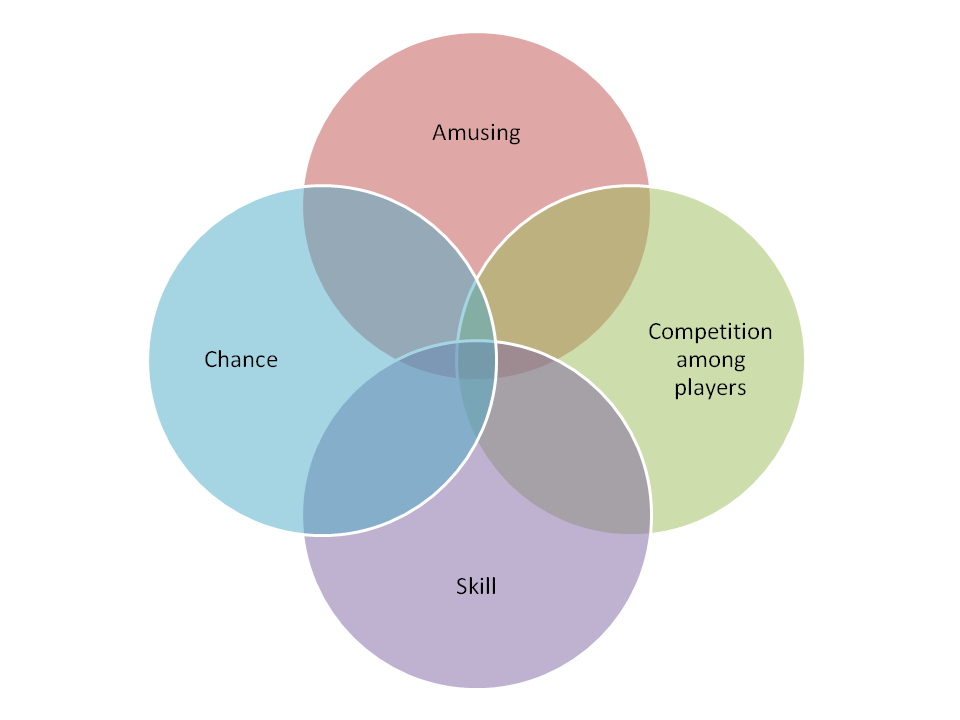
games2

I made this Euler diagram (which is not a true Venn diagram, according to the Wikipedian who made this page). Some of the games that Wittgenstein mentions, like Olympic track and field games, are amusing (in the sense of not being boring) and involve competition among players, skill and chance.

Other games fit only some of these criteria. There is no element of luck in chess or tic-tac-toe. There is no competition among players in solitaire or throwing a ball at the wall. There is no skill involved in ring-around-the-rosie. Tic-tac-toe is not “amusing.” Nevertheless, we call these all “games,” and if we tried to say that any of the four were necessary criteria we would exclude some of the games.

Similarly, these cannot be sufficient criteria either. Surgery involves skill, but it is not a game. Weather forecasting involves chance. War involves competition. Theater is amusing. That said, they are often compared to games, and described with game metaphors.

This is a good place to stop. I’ll talk in another blog post about how Hastings might be a village in this way.

The curious incident of the trans feelings

There’s an ugly bit of misinformation going around the Internet, that feelings of gender discomfort always get worse with age.  I discovered it the other day in the comments to a New York Tines “Ethicist”column responding to an older trans person.  The first comment was by a post-transition woman named Zoe Brain: “Gender Dysphoria varies in intensity, and is also progressive.”

It was echoed by another woman, Julie C. from Bala Cynwyd: “Trans is progressive, getting worse as the trans person gets older.”

The other night Natalie Reed tweeted this to me:

Because it WILL keep coming back. And it WILL get harder.

(Update: Natalie Reed was very angry when I tweeted her this post. She said that it’s basic Internet etiquette to ask before using someone’s tweets in a blog post, and that I damaged her ability to trust other trans people who reach out to her for help. Apparently she was under the impression I was asking for advice, not support. I honestly had no idea that some people followed this rule, and no intention of misleading her or abusing her trust.

As soon as Reed complained to me I apologized and removed the references to her from this post. She ignored that and spent an hour subtweeting her misunderstandings about my intentions. After several months with no response, I am restoring the references to her statements.)

The gist of this argument is that even if you’re not one of the “transition or die” trans people, if you don’t transition now you’ll eventually find yourself in that category.  There’s also an idea (which I generally agree with) that if you’re going to transition the earlier the better.  Put the two together, and you get an argument that every trans person should transition as soon as possible.

(I’m still not sure how you get from there to “anyone who doesn’t want to transition must not be trans,” but we can deal with that at some other point.)

For some people, feelings of gender discomfort and the desire to be the other gender definitely do get stronger over time.  I’ve heard this from many trans people, and I don’t want to discount their experiences.  But it’s not necessarily true, and it’s not automatically true.

Again we come back to the principle that no one really knows what’s going on with trans people, and no one will know until we get some kind of representative sample.  Generalizations with “all” and “always” are simply not appropriate.

I personally find that my discomfort with being a man, and my desire to be a woman, are not even perfectly correlated with each other, much less constant over time.  They both have their ups and downs, and I can connect some of those ups and downs to particular circumstances in my life, but not all of them.  Reed is right in that they both keep coming back, even after thirty years or so, but she’s wrong in that on average they haven’t gotten more intense or more frequent.

This is again the problem of negative evidence: we can see that for some trans people it gets harder over time, but we don’t necessarily notice that for other people it doesn’t get harder.  For every person who transitions or commits suicide, or even hangs on in quiet desperation, there may be one, or many, who lead relatively happy lives without transitioning, until they die.  We just don’t know.

What we do know is that there are some people like me, for whom it hasn’t gotten harder.  And that’s the thing about generalizations: they can be invalidated by even one counterexample.

We need support to not transition

I was disappointed to read in Helen Boyd’s blog that people have been attacking Christine Benvenuto for writing about the destruction of her marriage.

I was also very disappointed that Helen’s main solution was “People need to transition younger so that some of this can be prevented.”

That’s it? Transition younger?

I was glad that Helen posted (in comment number 3 on her post) a poignant anonymous reply from a closeted, non-transitioning trans person, that included a call for better counseling:

Treatment has at least gotten to the point that no one seems to believe that you can reroute our brains back to our genetically assigned sex. But the truth is, I simply don’t see anything in “treatment” that is helping us to find a path in the binary world that we don’t feel like we belong to. I love my wife and I love my family. There has to be some type of counseling to help the “responsible” TG family person and their families move to a place of less discomfort, less of the all or nothing options that seem are there for us today. Solid and consistent counseling to help us is desperately needed. It seems as though so few of us ever find peace with who we are, and to be pushed to choices that are also quite binary (closet or transitioned) seems ludicrous to me.

Sure, some people could avoid this particular class of tragedy by transitioning younger. But others, including people who missed their chance to transition younger, have chosen not to transition. They – we – can honor that choice, that commitment that we made to ourselves and our loved ones, and do what it takes to keep that commitment while still honoring, loving and respecting ourselves.

We can learn that transgender feelings are not static, but rather change with circumstances. We can learn about gender fog and the slippery slope, and how they affect our feelings and actions. We can structure our lives so that we enjoy them the way we chose to enjoy them, with the people that we love.

This is not repression. It’s not self-denial. It doesn’t mean being in the closet, hating yourself, living a lie. You can be out, trans and proud without transitioning. You can be true to your self. You can have the authentic life that the Transgender Law Center promises us.

And just like gay marriage doesn’t “destroy” heterosexual marriage, choosing to live as an out trans person without transitioning will not destroy other people’s transitions.

Is it disappointing? Of course. Is it frustrating? You bet. But it’s not depressing, and it’s not a life full of fear and despair. Show me the transgender life that doesn’t have its frustrations and disappointments. Show me the human life that doesn’t.

People can do this. It’s not for everyone. But for a lot of trans people it’s the best option. And the anonymous commenter is right that we need expert counseling. I’m not talking about reparative therapy or any of that self-denial shit. We need people who can help us navigate a path between repression and family disintegration, to avoid the slippery slope and identity fatigue, and to cope with gender fog. We need this to be included in the menu of “transgender health” options offered by clinics and covered by insurance.

Before we can do this, though, we need one very important thing. We need to smash transgender essentialism. We need to get rid of the idea that every transgender person has to transition. Transition helps a lot of people, but it’s not the only choice, and it’s not the best choice for some of us.

If you agree, please comment, link and reblog this, and post your own thoughts. And then, every time you see something that implies or assumes that all transgender people transition, please question it. Nothing will change if we perpetuate that fiction. If you do, email me at andrea@grieve-smith.com, and I’ll have your back.

“How could they do this to a family?”

When I was in fifth grade (the same age as my son is now), I had an argument with another boy in the class, a boy that I had been sort of friends with for a little while. At a certain point, his eyes narrowed, and he spat, “You dumb Jew!”

I was glad that my mom called his mom that night, and that his mom apologized to us, and got him to apologize to me. It was an inappropriate thing to say, and it needed to be dealt with promptly. But I wasn’t hurt.

I knew that some of the smartest people in the world were Jewish, and I knew that I was one of the smartest kids in the class. I was even mature enough at that point to know that the people who might be called “dumb” still deserved respect.

I also knew that my other classmates didn’t care that I was Jewish. They might have resented me because I got better grades than them, because I was a city kid, or because I didn’t make any effort not to cry. Or they might have quite legitimately resented me because I was a smart-aleck know-it-all. But even though they were all Catholics and Methodists and Dutch Reform and Jehovah’s Witnesses, it just wasn’t a big deal being Jewish.

So this boy combined a lie that wouldn’t have hurt me if it had been true (“dumb”) with a fact that I wasn’t at all ashamed of (“Jew”). How could this hurt me? I was hurt by the fact that this boy hated me so much he reached for what he thought would be the most hurtful thing he could say. I was hurt a few weeks later when he succeeded in convincing a mutual friend to reject me, through some combination of lies and bribery. But I wasn’t hurt by his words. They didn’t make any sense.

That’s the way I feel about Friday’s cartoon by Sean Delonas in the New York Post. The cartoon refers to the fact, recently discovered by the local political press, that Chirlane McCray used to identify as a lesbian and had sexual relationships with women, which she publicly proclaimed on the cover of Essence magazine in 1979. This is news because McCray has been married to a man, Public Advocate Bill de Blasio, since 1994, and they have two teenage sons.

Delonas’s cartoon shows McCray and de Blasio in bed smoking cigarettes, the conventional signal that they have just had sex. McCray, with a big smile on her face, is on the telephone telling someone, “I used to be a lesbian, but my husband, Bill de Blasio, won me over.” The bearded de Blasio is wearing a padded bra, panties, stockings, a garter belt and high heeled shoes over his hairy male body, and looks annoyed with the situation.

My reaction to Delonas’s cartoon was the same one that I had to this kid calling me a “dumb Jew” in fifth grade. Delonas starts with an obvious truth, that McCray once said she was a lesbian and had lesbian relationships, but which nobody should be ashamed of. He then adds a speculation that may or may not be true: that de Blasio cross-dresses when having sex with his wife. It’s probably not true, but if it is, it’s also nothing to be ashamed of.

It’s clear that Delonas is a nasty man who thinks that cross-dressing and being a lesbian are both things to be ashamed of. This is obvious in the cartoon, in the cartoon that he published today, and in his previous body of work. It’s also clear that he sees de Blasio as a political enemy and wants to hurt him. What’s not clear is why de Blasio should be hurt by this. It’s either a lie mixed with an obvious truth, or two truths together, none of which are anything to be ashamed of.

De Blasio is clearly hurt by the cartoon. At a rally Saturday, he announced “I’m offended they denigrated a woman who is a role model by any measure.”

A number of politicians, including potential rivals for the Democratic nomination for Mayor next year, were there to defend de Blasio. City Council Speaker Christine Quinn said that the cartoon was “the worst” thing in the coverage of McCray’s past. Former Comptroller and failed mayoral candidate Bill Thompson, who identified himself as a personal friend of de Blasio and McCray, said, “The first thing you think about is, my God, how could they do this to a family? How could they do this to their children? How could they do this? … While you won’t get an apology from the Post, on behalf of good people from New York, I’m sorry you have been dragged into this mud by this newspaper.”

Delonas clearly meant this as an attack, and I understand the impulse to defend yourself and your friends. But here’s the key: it’s only a successful attack if you believe that cross-dressing in the bedroom is something to be ashamed of. If there’s nothing wrong with a guy wearing a garter belt in bed, then it’s not denigrating anyone, it’s not doing anything to a family, and it’s not dragging anyone into the mud. When there is no shame, there is no mud.

What is worse, by being outraged, de Blasio and his friends have created the mud. If it is “the worst” thing to accuse someone of cross-dressing, what does that say about me and all the other cross-dressers in New York City? How many guys are going to feel a tinge of shame the next time they reach for their nylons?

I’ll tell you one thing: I doubt that de Blasio cross-dresses, but if he does, the most powerful thing he could do for New York City in his lifetime would be to come out of the closet and then run for Mayor. It wouldn’t be that much of a stretch, since Rudy Giuliani has already appeared onstage in nylons and heels. Even if he lost, he would accomplish more by being strong and running without shame than by anything he could do if he stayed in the closet and got elected. I think that Quinn and any other out gay politician in the city would agree with me.

Assuming that de Blasio doesn’t cross-dress, it would be a huge gesture to us if he and Bill Thompson could simply make a statement saying that cross-dressing is nothing to be ashamed of. All I want is seven words: “Not that there’s anything wrong with that.”

My life as a data point

I came across this quote in the abstract of a conference presentation by Sel J. Hwahng (on Page 7 of this PDF):

It is well known among public health researchers that in the U.S. the majority of male-to-female transgender (transfeminine) people are low-income people of color, while the majority of female-to-male transgender people (specifically those that identify as transmen, FTM, or genderqueer) are white and economically/educationally privileged.

I was floored by this statement, since I’ve been very adamant about the fact that we just don’t know what the majority of anything trans is, and about the need for caution when making any kind of statement involving proportions. The statement goes against my own perceptions, but I deliberately avoid reading too much into my own perceptions, because I know how much I don’t know. If this non-fact is “well known among public health researchers,” then my opinion of public health researchers just dropped quite a bit.

I was further intrigued to discover that I’m in those numbers. Me personally, I’ve been counted! Several years ago I volunteered for a multi-year study of male to female transgender people in the greater New York area. Every few months I’d go in, answer a bunch of questions, and get a blood test and a few bucks for my trouble. I didn’t do it for the money, which was well below my hourly rate for computer work. I was contributing my data, in part to provide a counterpoint to the idea that all transfeminine people are low-income people of color. I guess it only goes so far.

It turns out that Sel Hwahng was one of the researchers. I might have talked to him once or twice, but I mostly dealt with Mona Rae Mason and Monica Macri. And yes, non-Hispanic white people counted for only 27% of study participants and people making more than $30,000 a year were only 26%, so us well-off white people are certainly a minority of the study participants. No, you can’t generalize from that, but then again I didn’t really talk sampling with anybody while I was there.

Reading that abstract got me looking up the results that have come out of the study. Sel Hwahng used some of the qualitative data in this report from 2007, showing how the MTF trans population in New York is segregated into distinct communities based on ethnicity: black/latin, asian and white. It’s got a lot of interesting existential observations, but I could do without the implication that all of us “middle-class White cross-dressers” are just waiting to break up with our wives to transition. Some of us plan to die as men.

In 2009 the whole group published a report using the quantitative data to argue that life for transgender people is more complicated than Ray Blanchard’s simplistic “homosexual” and “autogynephilic” dichotomy. They then got into a thing with Anne Lawrence about it. What I find most interesting is that among the study participants were 221 people who reported that at some time in our lives, wearing feminine attire was “sexually arousing,” including 90 who reported not being attracted to non-transgender females, and 58 who reported not being attracted to non-transgender males. One of those 58 is me.

In 2011 the group published another report based on questions about verbal and physical abuse, and whether such abuse was related to gender identity or presentation. They showed that MTF transpeople who experience that kind of abuse tend to be more depressed, and also to have more unprotected anal sex, and to be at greater risk for HIV infection. I’m glad to say that I didn’t have any abuse, depression or unprotected anal sex to report, and I didn’t test positive for HIV. I’m sad to read that there were 107 people who came in and told Monica or Mona that they’d been verbally or physically abused, 145 who were depressed, and 43 who had unprotected anal sex with a casual partner or a john. The point of the article is that one way to overcome AIDS is to stick up for transpeople, and of course that’s a message I support.

The 2007 report makes unsupported leaps even without explicit quantitative statements, but in the 2009 and 2011 reports, Larry Nuttbrock was very careful to include disclaimers about the limits to generalizing the results. I’m glad he did, and I think his conclusions were mostly justified. Overall, I’m satisfied with the reports that have come out of this study. It was an interesting experience to answer all those questions. I wonder what they’ll do next.

What is transphobia?

You’ve all heard the Trans 101 definition: “irrational or persistent fears or non-acceptance towards people whose gender identity or expression differs from the gender they were assigned at birth. Transphobia can lead to direct or indirect discrimination or harassment in a variety of forms; the common theme is a misunderstanding of, or failure to respect, gender diversity.”

Are you ready for something more advanced – say, Trans 201? It’s all very well to declare that someone’s fears are irrational, and many of them sure are, but that doesn’t really tell us much about where they come from, so it doesn’t help us to stop it. We can only get true understanding through empathy and compassion. I count at least eight distinct reasons for someone to feel afraid of or hostile towards a transgender person. They all have different sources, and they all call for different responses. Lump them together at your peril.

  • Entitlement policing: the fear that someone is getting away with something they don’t deserve. This is behind bathroom anxiety and so much more. It’s even more intense if the self-appointed border guard believes that the transgender person in question needs to be made an example of, or else “they’ll all want one.”
  • Moral condemnation: the belief that transgender behavior is immoral and must be punished. Usually there is no reason given for this condemnation, it’s just written in a book somewhere.
  • Sissy discipline: the belief that “men” (particularly young ones) who refuse to accept male roles must be punished for shirking their duties.
  • Deception rage: anger based on a belief that someone has deceived you to gain something valuable from you, including but not limited to sexual gratification. This is a factor in many murders of transgender people.
  • Fear of unintended consequences: fear based on the belief that someone may be unintentionally putting themselves in danger, or making a choice they may regret.
  • Fear of shaming or retribution by association: the fear of being attacked for having loved, cared for or been intimate with a transgender person. This is a legitimate fear based on events such as the murder of Barry Winchell, Calpernia Addams’s boyfriend, in 1999. It is also a factor in murders of transgender people.
  • Fear of self-hatred: some people who are intimate with transgender people criticize themselves for it, especially if they believe that it means they are “gay.” They may further believe that killing their lover will somehow absolve them of “gayness” or demonstrate their rejection of it.
  • Fear of shaming or shunning of a transgender loved one, by others or even by oneself. Yes, some people attack their loved ones because they don’t want to feel obligated to attack them in the future. How messed up is that?

Do these make sense to you? Am I missing anything?