We are all non binary

I’ve written about how I don’t feel non-binary because I jump from one side of the binary to the other. But that’s not all of it: my masculine gender expression (of the two, the one that’s best developed) is not very binary, and never has been. But I don’t feel like that part is exceptionally non binary. Everyone’s actions are non binary to one degree or another. I’ve just been more comfortable with my non binary actions than a lot of other people.

The reasons we draw lines between men and women are to decide who gets access to what roles and spaces, what we expect from people, and how we’re going to treat them. But no matter where we draw the line between men and women, most people are not going to fit perfectly on one side or the other. I’ve met a lot of people over the years, and when you get to know them, everyone is pretty non-binary.

Do I look non-binary to you?

As I write this I’m wearing all “men’s” clothes and accessories, bought in the Men’s department. I have my fingernails cut short, and I shaved my facial hair using a men’s razor. I’m not wearing makeup. I’m going to my job as a university professor. Tomorrow I will go to my research position in computer science, a continuation of my many years working in information technology. All roles and spaces that have traditionally been “men’s” in middle-class white American society.

I’m doing a lot of things that are unmarked for gender. I’m drinking a latte and riding the subway. I’m writing on a tablet. I’m carrying a backpack. I get together with friends. I go to political meetings. I post on Facebook and Twitter and Tumblr and my blogs.

In my life as a “guy,” I do some things that have traditionally been “women’s work.” Tonight I’m going to meet with my kid’s teachers. Sometimes my wife goes on business trips and I’m taking care of the kid by myself for days on end. When he was a baby I fed him and changed his diapers. I buy almost all of my own clothes. Yesterday I did laundry, for the entire family. On Friday I’ll cook dinner, and probably buy groceries. Tomorrow I might clean the bathroom and go to Weight Watchers. I’ll eat salad. When I was younger I worked as a secretary and ate Special K cereal. I’ve studied yoga and dance. All traditionally women’s roles.

Of course, I’ve known women who wear no makeup, who wear “men’s” clothes, who trim their fingernails and even shave their faces. I have always had plenty of colleagues who were women, in university teaching, in computer science, and in information technology. There are lots of women in university teaching, but in other parts of the country it’s still unusual for a woman to be paid to open up a computer.

I know other guys who take care of their kids, including the feeding and diapers. I was told once that a particular temp agency in another city would not send men on secretarial assignments, but here in New York I met a number of other male secretaries. When I’ve traveled, most of the Weight Watchers meetings I’ve been to have been dominated by women, but here I see men at practically every meeting. Most of the guys I know buy their own clothes, and a lot of them wash the family’s clothes and clean the bathroom and cook dinner. Whenever I studied yoga or dance, there were other guys there. I see guys at Just Salad, and maybe even eating Special K. This means a lot of people crossing traditional gender boundaries.

I do know some people who are pretty damn conventional about gender roles. Women who never wear pants outside the house, men who won’t touch a stove. People who repeat things that sound like they’re straight out of some Victorian etiquette guide. But when I’ve gotten to know these people, there’s always something surprising about them. A woman who started her own business. A man who raised his kids without a woman in the house. Every single one. I’ve never met someone who fit completely within standard gender norms.

Now here’s a problem: essentialist stances on gender rely on binary policing. Whether you say, “all males are men” or “trans women are women,” you’re saying that it matters who’s a man and who’s a woman. Not that it matters for some practical sense, like bathroom access, but that beyond all practicality, it matters to you. Otherwise you’d just say that everyone should be allowed to use the bathroom they choose.

This is a problem because of all the non binary actions I described, all the people who don’t necessarily identify as “non binary” or transgender, but do things that cross gender boundaries. No matter where you place the boundaries, some people will cross it, and some will be straddling it.

Any essentialist approach to gender based on birth assignment will necessarily leave a lot of people unsatisfied. An essentialist, binary approach based on socialization will still erase a lot of people by ignoring the messy gray areas of socialization. An essentialist approach based on professed belief or the observer’s gut feeling (which are the only evidence ever accepted for “gender identity”) ignores and erases my reality, and really, everyone else’s, even if they profess a gender identity, because everyone crosses gender boundaries.

So here are my questions to everyone who believes that there are essential differences between men and women, whether by birth assignment, socialization, professed belief, or your personal judgment: When you divide the world of people into men and women, which roles, spaces and treatments are reserved for one gender or the other, and which are open to all? Does your definition allow my reality? Who would violate your categories? What are the consequences?

When Amtrak misgendered Chelsea Manning

Via Lectraerror on Tumblr, Amtrak has started a website called “Ride With Pride” to reach out to LGBT passengers:

Amtrak believes in diversity. For us, it’s more than a corporate buzzword. It’s an appreciation for all people. We believe every great adventure begins with an amazing experience. Our goal is to provide that experience, time and time again. It doesn’t matter who goes along for the ride.

I’m glad to hear that, but they’ve got their work cut out for them. I immediately thought about Chelsea Manning’s trip on Amtrak in 2011, and went back to re-read what she told Adrian Lamo. When one conductor saw the name “Bradley” on her ticket, he intentionally misgendered her in a way that made her uncomfortable:

(03:17:04 PM) bradass87:i went on leave in late january / early february… and… i cross-dressed, full on… wig, breastforms, dress, the works… i had crossdressed before… but i was public… for a few days

(03:17:33 PM) bradass87:i blended in….

(03:17:34 PM) bradass87:no-one knew

(03:18:06 PM) bradass87:the first thing i learned was that chivalry isn’t dead… men would walk out of their way and open doors for me… it was so weird

(03:18:19 PM) info@adrianlamo.com: awww.

(03:18:51 PM) bradass87:i was referred to as “Ma’am” or “Miss” at places like Starbucks and McDonalds (hey, im not a fancy eater)

(03:19:35 PM) bradass87:i even took the Acela from DC to Boston… whatever compelled me to do that… idk… but i wanted to see my then-still-boyfriend

(03:20:01 PM) bradass87:i rode the train, dressed in a casual business outfit

(03:20:36 PM) bradass87:i really enjoyed the trip… minus the conductor

(03:21:06 PM) bradass87:as he asked for my ID, and clipped my ticket… he made a fuss

(03:21:24 PM) info@adrianlamo.com: that sucks =z

(03:21:26 PM) bradass87:“Thank you, MISTER Manning…”

(03:21:31 PM) info@adrianlamo.com: asshole

(03:21:35 PM) info@adrianlamo.com: him, not you

(03:21:41 PM) bradass87:i know

(03:21:53 PM) bradass87:it was… an experience i wont forget…

(03:22:36 PM) bradass87:i mean… 99.9% of people coming from iraq and afghanistan want to come home, see their families, get drunk, get laid…

(03:22:56 PM) bradass87:i… wanted to try living as a woman, for whatever reason

(03:23:14 PM) bradass87:obviously, its important to me… since there were plenty of other things i could’ve done

(03:23:23 PM) info@adrianlamo.com: Overall, how did you feel about your sojourn?

(03:25:50 PM) bradass87:idk, i just kind of blended in… i didn’t have to make an effort to do so, it just came naturally… instead of thinking all the time about how im perceived, being self conscious, i just let myself go… …well, i was still self-concious, but in a different way… i was worried about whether i looked pretty, whether my makeup was running, whether i spilled coffee on my (expensive) outfit… and to some extent whether i was passing…

(03:28:12 PM) bradass87:but i went to get gas… and bought cigarettes (i know, need to quit)… and the man asked to see my ID… so i did… and he about had a heart attack… he couldn’t hold himself back, he looked up and down twice… and gave me this look like… WTF, it is the same… handed it back to me… and tried to keep himself composed… so i wasn’t worried about whether i was passing as much, because he had no idea whatsoever

(03:28:55 PM) info@adrianlamo.com: i smoze zero to five a day myself.

(03:29:44 PM) bradass87:but the point was, i guess my face is androgynous enough that i can pass with ease

(03:30:11 PM) bradass87:my prominent adams apple is the only issue i was concerned about

(03:30:26 PM) bradass87:so i wore a turtleneck, and had collar up with my coat

(03:30:29 PM) info@adrianlamo.com: yeah, i’d say that re. the former.

(03:30:38 PM) info@adrianlamo.com: which i find cute.

That’s the relevant part, but the whole logs are worth reading.

We’re not talking like the conductor couldn’t tell and made a guess. Manning was wearing business casual women’s clothes and makeup, and said that everyone else who saw her called her “ma’am” and opened doors for her. This guy saw a man’s name on her ticket and chose to make a big deal of it. That’s not cool.

And from this we can conclude that if Amtrak really wants their customers to Ride With Pride, we need to know that that kind of treatment won’t be tolerated. Contact information for a trans-friendly ombudsperson would be a big step.

Soft body mods

Many people who have transgender feelings deal with them through body modification, or “body mods.” Some feel better if they see in the mirror a body that looks more like the gender they want to be; others feel better if they are treated as the gender they want to be, so they change their appearance in order to increase the chance that this will happen.

Selfie
Hair removal is a soft body mod
When we think of transgender body mods, the first one that comes to everyone’s mind is “the surgery,” meaning genital surgery. There are other surgeries that people talk about, and the modifications that happen with hormone use. There is long-term hair removal through electrolysis. Finally there are the toxic modifications produced by the “pumping” of silicone and other substances into bodies by exploitative quacks.

The body mods I’ve described are permanent, or at least very hard to reverse. There are short-term grooming procedures like makeup, clothing and wigs, which can be removed within an hour. In between are medium-term changes that Helen Boyd has called “soft body mods,” which don’t last forever but are hard to reverse in the short term.

Helen tells a story of meeting people in a bar near a trans convention and knowing instantly that they were cross-dressers, even though they weren’t cross-dressed at the time. She noticed things like pierced ears, sculpted eyebrows, lack of facial or body hair, haircuts that could work for either gender presentation, clothes that look similar to men’s clothes but were cut for women, and long fingernails with clear polish. Lots of non-trans men have one or two of those things, but relatively few have more than two.

Many non-transitioning trans people are careful about their muscles: not too big for male to female people, bigger for female to male. We may also try to gain or lose more fat in the places that look right for our target gender presentation, even though many people say that targeted fat loss doesn’t work.

There are also behavioral changes that affect how our bodies are perceived. Some of us try to walk or stand or hold our arms in a way that minimizes signals of one gender and highlights signals of another gender, and we may try to modify our voices to sound like our target gender. (The extent to which we succeed is a matter of debate, but it’s clear that some of us try).

These behaviors and postures are temporary changes, but if they become routine they can change our muscle memory and “bleed over” into our other gender presentations. If this happens with influential people, it can be copied by others. This could be part of the origin of the movement and vocal patterns we see in some gay men, that are stereotyped as “swishing” and “lisping.”

Body mods are not always permanent, and they’re not always obvious. Without being permanent or obvious, they can affect the way others see us, and the way we see ourselves. And they’re not all cheap; many of them represent a significant investment of time, money or both.

The Power of Glamour and transgender feelings

Seven years ago I talked about the notion of glamour as described by Virginia Postrel. Virginia has been working on a book about glamour, and it was published on Monday. Here’s the definition from the book (as of last year):

Glamour is not the same as beauty, stylishness, luxury, sex appeal, or celebrity. Glamour is, rather, a form of nonverbal rhetoric, which moves and persuades not through words but through images. Glamour takes our inchoate longings and focuses them. By binding image and desire, glamour gives us pleasure, even as it heightens our yearning. It makes us feel that the life we dream of exists, and to desire it even more. We recognize glamour by its emotional effect—a sense of projection and longing—and by the elements from which that effect arises: mystery, grace, and the promise of escape and transformation. The effect and the elements together define what glamour is.

The Power of GlamourYou can probably see why I was immediately struck by the connection to transgender feelings. My strongest trans feeling is that longing to escape from my male reality, with its career obligations and social frustrations, where I’m expected to go out and get what I want, into a dream world where all I have to do is put on the right clothes and everyone will pay attention to me, desire me, and give me what I want. (Yeah, right!)

To me, glamour explains the connection between gender dysphoria, my feeling of unhappiness with being a man, and gender desire, my desire to be a woman, to be seen as a woman. There are lots of men who are unhappy being men, but only some of us want to be women. Glamour helps us understand why we do.

As Virginia has pointed out, this is compatible with the Official Trans Narrative: if you have an innate sense of gender that doesn’t match your physical sex, then you’re likely to be unhappy and thus feel a desire to escape your birth gender classification. But for those of us not convinced by the innatist narrative, glamour opens the door to other explanations.

Since then I’ve followed Virginia on her blogs and on Twitter, and in June she mentioned that she visited my blog while checking footnotes. On Monday night I had the pleasure of meeting her in person at the book launch party, and found that I’m quoted on Page 63, connecting glamour with despair:

I came to the idea of despair based on Virginia’s characterization of glamour as a means of escape. If you’re trying to escape through a fantasy you have to be pretty desperate, right? That’s the sense of “despair” that I mean – a feeling of being trapped and having no options left.

To Angus/Andrea with thanks & best wishes - Virginia

That’s from a comment I left on an article Virginia wrote in 2008, expanding on the connection Salman Rushdie made between terror and glamour. In the book, she expands on my connection to despair by noting the glamour elements highlighted in the documentary Paris Is Burning.

The glamour response is powerful. It can move us to approach strangers, to buy houses, and to blow up buses full of people. It can also move us to cross-dress, to get surgery to change our bodies, and to declare gender transitions.

What I’ve read of the book so far has been great. I encourage anyone who’s interested in transgender feelings to get a copy. I’ll be posting more about it in the future.

The big tent and the Day of Remembrance

In my family, when we celebrate Passover we often have non-Jewish friends join us for dinner. Enjoying their company in an overtly Jewish context helps to defuse potential prejudice, and the specific activity of the night, the retelling of the story of slavery in Egypt and our exodus from it, gives them the opportunity to condemn the slavery and in turn reaffirm their tolerance for us and our different practices.

I should point out here that I’m actually not that different from our guests, being half-Scottish and pretty well assimilated. Like most American Jews, I don’t do much outside of Passover and Hanukah. My Jewishness is much more a matter of cultural heritage than religious belief. I checked online and this inviting non-Jews is apparently a relatively new tradition: there are some people who believe that non-Jews should never participate in a Seder, because it involves sacrificial lamb meat. The rabbinical consensus seems to be that since the Romans destroyed the Temple there’s been no such thing as true sacrificial lamb, and Paschal lamb is just a tasty symbol.

The reason I’m telling you about our tradition of sharing Passover is to note that we do not challenge the separate identities of our non-Jewish friends. We do not ask them to believe in our god or pray to him. We do not ask them to believe the plagues and miracles. We don’t give them a hard time if they fail to use the proper forms of addressing our god, including capitalization.

We simply ask our friends to accept the historical aspects of the story, and to reassure us that they do not approve of enslaving minority populations. We give them the opportunity to reaffirm their acceptance of us as friends and neighbors, deserving of respect and equal treatment.

I propose that we as trans people do the same with the annual Transgender Day of Remembrance. This is a day (November 20), when we talk about those of us who have been killed, for being trans and presenting as women, and often for being poor at the same time, for not being white, for being immigrants, for loving men and having sex with men.

We trans people are diverse, but we have a lot in common with each other and with lesbians, gay men and bisexuals. Among our family, friends, spouses and lovers, there are many people who share goals with us. Those are the people we want to have by our sides when we are fighting for our goals, celebrating our lives, or supporting each other. Like most trans people I know, there are times when I want to be treated like my target gender (a woman), with the appropriate pronouns and facilities. These are the people who are most likely to treat me this way.

The problem is that a lot of trans people treat alliances like they’re black and white. You’re with us or you’re against us. You believe in essentialism and determinism, and you support our entire agenda, or you’re worthless. I understand why people use these ideological tests to screen allies: someone who doesn’t believe that we’re even provisionally women (or men) is likely to bargain away some of our rights. You don’t want to depend on people who don’t really share your goals.

The key is that alliances are never permanent, and if you act like they are it’ll get you into all kinds of trouble. An alliance is not absolute trust, it’s just a recognition of shared goals. When you’re dealing with goals that aren’t shared, the alliance is meaningless.

As I wrote before, there is a large number of people who believe that we shouldn’t be killed for being trans. Not killing us is an idea with broad appeal. A lot of those people will not be on board with free surgery on demand, or birth certificate changes, bathroom rights or even using our preferred pronouns. But they are on board with not killing trans people. If we don’t let them show it, that’s our loss.

We should follow Incohate Erica’s principle of nihil de nobis sine nobis: feminine spectrum trans people who are poor, nonwhite, immigrants and sex workers should be at the center of any Day of Remembrance activities. They, not me, not other bloggers and authors, and not the leaders of mainstream service and advocacy organizations, are the ones most at risk, and they should be doing most of the talking. And their loved ones, who also suffer greatly, should share center stage.

We trans people who are not most at risk should participate too, out of solidarity and because every once in a while one of us gets killed too. Our dependable allies should be there too. But on this day, and on this day most of all, we should reach out beyond our normal alliances and build new alliances around the shared principle of not killing us.

This year Queens Pride House will be observing the Day of Remembrance a day late, on November 21. I will attend, and I have made the case to other members of the support group that we should reach out beyond our normal comfort zone to people who are on board with not killing us, but maybe not much else. I hope you will consider doing the same. If you’re not trans, check with your local Day of Remembrance organizers to see if you’d be welcome. And consider writing a blog post or an editorial that will reach people who might not normally think about this issue, making it clear that you don’t think anyone should be killing us. They need to hear that.

Presentation fatigue

I thought about going out presenting as a woman today. I really had too much work to do, but even if i hadn’t it would have meant spending over two hours on my presentation. It’s mostly makeup, but it’s also showering, shaving (face and chest), brushing teeth, deodorant, picking out clothes and getting dressed. Every couple of weeks I need to spend an hour shaving my legs. I usually don’t bother painting my nails unless I’m planning to present as a woman all day. Today, instead I skipped all shaving, brushed my teeth, showered and dressed in about twenty minutes.

SAMSUNGI know this difference is not just because I’m trans. The line, “But it takes me so long just to figure out what I’m gonna wear,” in “Manic Monday” resonate with non-trans women because our society polices women’s presentation much more strictly than men’s. Laura Topham spent eight hours getting the “Essex girl” presentation, and a lot of it was procedures like hair extensions and spray tan that full-time Essex girls don’t get every day, but the average woman spends more than twenty minutes a day on her presentation. Even many men spend more than I do to go out as a guy. When I was in high school, a friend of mine would be in the bathroom for hours.

But my female presentation requires more than the average woman, and if I had transitioned it wouldn’t take as long. I would have gotten permanent hair removal, so I wouldn’t have to shave anywhere near as much, or put on so much makeup, and hormones would have reshaped my body to some extent.

If I had chosen to transition in my twenties my shoulders probably wouldn’t be as wide, so I wouldn’t have to be so careful about my clothing choices. In fact, when I first started wearing women’s clothes in my teens, I wore anything I could find. I never wore makeup, because I didn’t have much facial hair until my twenties. Going out in public has also raised the stakes. When I was fifteen, my presentation time was about ten minutes.

The presentation has always been part of my enjoyment of presenting as a woman. But not two hours of it. Not worrying that if I miss a spot on my foundation I might get sirred or even beaten up. Not worrying that if I nick my ankle I’ll have a scab for days and a spot for weeks. Not worrying that if I get my tuck wrong I’ll be uncomfortable for hours.

But of course, I will be uncomfortable for hours, because wearing heels and nylons and makeup and “foundation garments” is uncomfortable. On top of that, even a good tuck is uncomfortable, and so is a padded bra and enough makeup to hide a beard shadow. Some people put up with that every day for years. I’m okay with it once in a while.

I know some of you transitioners who are reading this are thinking smugly, “I don’t have to shave. I don’t even wear heels or makeup most days! I’m a -” Yeah, we get it. That was the point of this post. The point is that this presentation fatigue is a factor in decisions to get permanent hair removal, to take hormones, and even to get genital surgery. Presentation fatigue is a factor in transition.

Colonizing ontologies

Brin pointed me to a great blog post about how we relate to other people’s categories, especially the categorical systems used by other cultures. (The author, posting as “Boldly Go,”* calls them “epistemologies,” but they seem to be what I’ve heard called “ontologies” or “taxonomies.” I think “categories” is the most straightforward term. And yes, I do recognize the irony there.) Boldly Go also makes the point that these categories are referred to as “social constructs,” which mean that they’re not essential and can vary from culture to culture – and, critically, that they change over time, even in a single individual.

Boldly Go argues persuasively that abolishing gender is not a realistic approach. We all have a basic need to categorize people: who is a potential ally, sex partner, life partner, co-parent, leader, friend, collaborator? Who is a potential attacker, rival, rapist, burden? Figuring all those things out based on the individual characteristics of everyone we encounter would be exhausting and time-consuming, so we use roles and spaces based on gender and other categories as shortcuts. This becomes truly problematic when we forget that these categories are only shortcuts, when we essentialize them.

Here’s my favorite part of Boldly Go’s post:

Hidras of Panscheel Park II, New Delhi, India, 1994. Photo: R. Barrez D'Lucca / Flickr.
Hidras of Panscheel Park II, New Delhi, India, 1994. Photo: R. Barrez D’Lucca / Flickr.

For example, a great many people familiar with the trans* community may have heard of hijras, a concept of gender that exists within South Asia. A great many usually white trans* people have called hijra’s “trans*” or put them under the trans* label. Regardless of their intention, to take the epistemology of “trans*” and apply it to something like the hijra can be seen as an oppressive or colonising act. The hijra are hijra. That is their name. Unless a hijra specifically identifies as transgender or trans*, applying our own concepts of gender and sexuality constructed within white supremacist cultures to people outside of our epistemological framework is redefining them on our own terms for our own benefit.

They (that’s Boldly Go’s preferred pronoun) go on to talk about two-spirits and quote their friend Tiara’s thoughts about gender in Malaysia and Bangladesh, and to argue that gender abolitionism is colonization in the same way.

Much as I agree that it’s not realistic to abolish gender, I think it’s not realistic to ignore our own gender categories when trying to understand people from other cultures. We may say, “that’s kind of like our idea of ‘transgender,'” but it becomes problematic when we ignore the way others categorize themselves. It becomes colonization when we seek to replace their categories with our own. And it’s downright offensive when we act as though our way is the One True Way of categorizing the world.

This is not to say that it’s all relative, and all categorization systems are equal. Some may have particular virtues relative to others. But we can’t just assume that our own categorization system is superior. We have to make a coherent argument for it.

I’m less concerned with borrowing another culture’s categories. If it’s done respectfully and with full credit and an open mind, it isn’t appropriation. It’s just recognizing that other people may have come up with a better way of doing it than we did.

I’ll have more to say on this in the future.

* Boldly Go seems to have let her domain expire, so I’ve changed the link to point to a copy she posted on Medium under the name Lola Phoenix.

Gender roles are a kludge

A while ago I talked about gendered spaces, and how they’re something of a kludge, a shortcut. Gender roles are also a kludge, but one that’s even less justified than gendered spaces, given what we can do with modern prosperity and technology. They persist out of some combination of tradition, politics, personal preference and convenience.

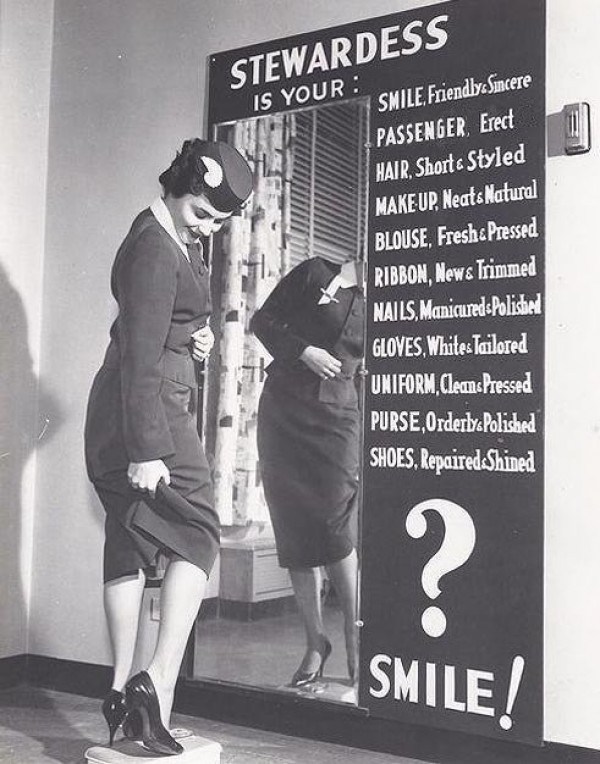
Stewardess: Is your...
Photographer unknown.
The primary sex difference is of course the ability to bear children, so a thousand years ago if a man wanted to raise healthy children, the way to get them was by marrying a healthy, young, maternal woman. Of course, not all women can bear children, as numerous frustrated European kings have shown us, but looking for a man was definitely an unproductive strategy.

Nowadays it’s possible for gay couples or even single men to adopt children, so women are no longer necessary, but marrying a woman is still the most convenient way to get children, and it’s acquired the weight of tradition and politics. For men who are sexually attracted to women, marrying a woman tends to be the preferred way of getting a child, because it pretty much ensures that the man will have sex with a woman.

Other gender roles are based on secondary sex characteristics: men tend to be larger and stronger, so they’re preferred for fighting, smashing and lifting. Women tend to be able to lactate, which made them the obvious choice for caring for infants before formula was perfected.

Once these roles are established, they make it easier to segregate other roles. If women are taking care of infants, it’s easy for them to keep caring for older children, and eventually for the elderly and sick. If childcare happens mostly in the home, it makes sense for women to take care of other household needs.

If men are fighting, it makes sense for them to be policing internal order, and then it’s easy for them to be the ones who set the internal order. If they’re smashing and lifting, it makes sense for them to build houses and fortifications, and then it’s easy for them to be the ones who make machines.

Women and men also tend to form communities of practice based on these activities. Any father who’s spent time with a “mom’s group” knows what I mean, as does any woman who’s attended an engineering conference.

All these tendencies make sense. What doesn’t make sense is to be so rigid about them. Natural variation means that these sex characteristics aren’t a given. Some people are naturally infertile. Some women are big and strong, and some men are small and weak.

Technological and social changes have made a lot of these biological generalizations irrelevant. If we do most lifting and killing today by pushing buttons, how strong does a soldier or construction worker have to be? If we can feed infants with formula, we don’t need nursery school teachers to have functioning breasts.

Some roles have undergone gender flip-flops, or simply diversified over the years. In the nineteenth century, the position of secretary was considered too cerebral to be entrusted to women (with all the misogyny that implies), then in the late twentieth century it was treated as exclusively female; in Binghamton in 1992 a retired temporary placement agent told me that they would never send a man on a secretarial assignment. “Stewardesses” were once all female and doctors male, but last month I flew on a plane where most of the flight attendants were male, and my last dermatology appointment was at a practice that was mostly women. The best nurse in my son’s neonatal ICU, who taught me to change a diaper, was a guy named Scott.

There have long been exceptions to these roles. The US Army’s recent official inclusion of women in combat is notable, but women have been fighting throughout human history. There have been women leaders and male nurturers.

There will probably always be roles in every society that are more strongly associated with one gender or the other. There will also be people who will, for one reason or another, be drawn to the other roles. We need to be flexible and ask if there’s really any good reason why a role should be rigidly reserved for one gender. If there isn’t, we should accommodate everybody.

Come jump on the “Don’t kill trans people” bandwagon!

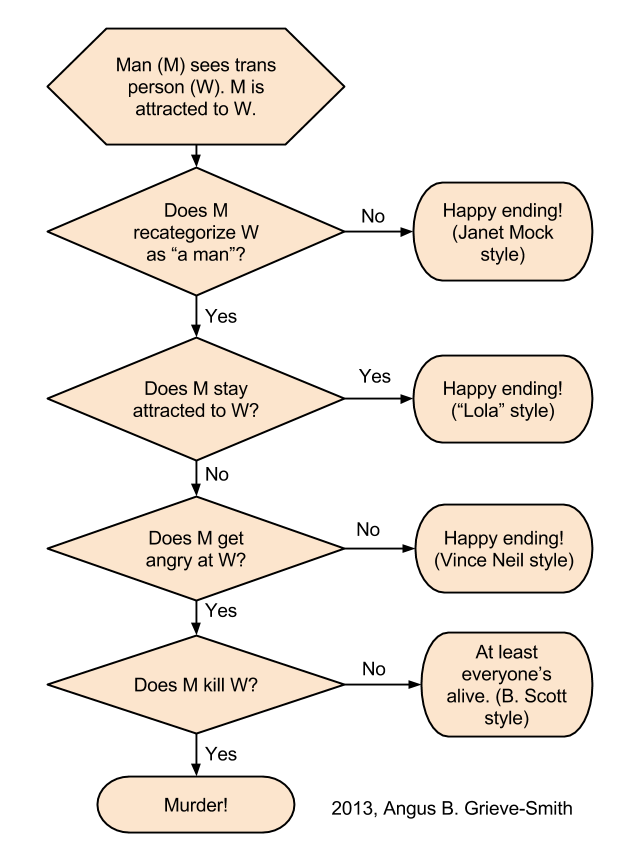
The killing of Islan Nettles in July followed an all-too-typical pattern: a man classified her as a woman, found her attractive and flirted with her. He then reclassified her as “a man,” fought her and killed her. In response to this terrifying event, I’ve told you about two alternative visions for this type of scenario. In Janet Mock’s vision, everyone accepts all male to female trans people as women, that status as is never questioned, and the man never feels any desire to attack her. In Desmond Child’s “Dude (Looks Like a Lady),” people may see trans women as men, but we can still be attractive, and there is no shame for any man who is attracted to a trans person.

Those are definitely the best alternatives, and I pefer the second, but there’s a third one. It isn’t as good, but it’s still better than what happened to Nettles. It’s simple: nobody should die just because they’re trans.
Outcomes2
Here’s my vision: A man sees a trans woman and is attracted to her. He reclassifies her as “a man,” and loses interest in her. Maybe he even feels angry and calls her names. Maybe he even attacks her physically. But he doesn’t kill her.

This is what happened with Lewis Dix, Jr. and B. Scott. Dix called Scott a “faggot,” and Scott was right to give him hell for it. But Dix stopped there. He didn’t attack.

Nettles’ killer could have stopped at name-calling. Or if he didn’t stop there, he could have stopped after a punch or two. Even if he was too drunk or too much of an asshole to stop, his “crew” could have stopped him. They could have said, “It’s okay, we get it, you’re not gay.” they could have said, “This is a human being who doesn’t deserve to die.”

I know, it doesn’t seem like a lot. I wouldn’t be satisfied with “just” being called names and beat up. But it would be better than what currently happens to black and Latina trans people.

The thing is that there’s a large constituency for not killing trans people. A lot of people don’t think we’re women. A lot of people don’t think we’re sexy. Some people think we’re sinners. Some people think that any man who’s attracted to us is gay, and that being gay is bad. These people may disapprove of us in all kinds of ways, but they don’t think we deserve to die.

This constituency for not killing us is largely untapped. On stage at the vigil for Islan Nettles were her family, three trans people, and some lesbians and gay men. Attending were people from the entire trans spectrum, and straight allies, including several politicians. Besides the politicians, what I didn’t hear about were “thought leaders” in broader African-American culture beyond LGBT subcultures: clergy, musicians, actors, athletes.

Who are the people that Nettles’ killer and his “crew” listen to? What if they said, simply, it’s not okay to kill someone because they’re trans? What if we asked them, nicely, to say it now? Not to say “trans women are women,” not to say “it’s okay to be gay,” and not to say anything negative about us either. Just “Don’t kill trans people.”

How many of them would sign a statement? How many would appear in a public service announcement? How many would perform in a music video or television episode?

Don’t get me wrong. I want more than this. I want people to treat me with respect. I want people to treat those who love me with respect. I want to be treated like a woman when I present as a woman. I know you want those things too.

I’m not giving up on what I want, and I’m not telling you to give up on it either. Laverne Cox argues that it’s the same problem, that we need those things to be safe, to be alive. The actions of Robert Wace and Lewis Dix, Jr. show us that that’s not true. People don’t have to endorse our entire program before they can treat us like human beings. They don’t need to agree with us about anything else to speak out against the violence. Let’s get them to do it.

Gender fog update

It’s really hard for me to write this post, because it’s not my highlight reel.

I worry that someone might read this and use it to undermine my credibility on issues that are not really related to it. I worry that people might make incorrect assumptions about me based on this.

Still, I think it’s important to post this. Not very many people are writing about gender fog. But I’ve talked to other people, and I know I’m not the only one who feels it. So here goes.

As I wrote back in July, I went out in public as a woman and had some serious gender fog. I actually had difficulty sleeping for two weeks. I finally decided to go out cross-dressed again, and the night between making the decision and going out was the least restful of all. After that I had one more difficult night, and then my insomnia returned to its baseline.

x
I couldn't hold the phone steady for long enough to take a picture. That's how excited I was to go out for the second time this year. I don't want to get that excited.
Last Saturday I went out for the third time this year, and this time I only had trouble sleeping the night before. Since then, I’ve been back to normal. I don’t know for sure why I had such a strong reaction back in July, but I have a few guesses.

When I went out in July, it was the first time in two years, and that made it much more exciting. In August and again this weekend, it had been a month or less. It was still exciting, but not exciting enough to keep me up for several nights. So that was a factor.

I also got a lot of affirmation in July. I spent the afternoon with one of my best friends, and he was really nice to me, even though he’s going through a lot of his own issues. He said I looked good, said he didn’t know how anyone could have read me. He picked out clothes for me to try on and gave me helpful feedback. He asked thoughtful, sympathetic questions about my trans feelings and experiences. I also dealt with security guards who were uniformly polite, friendly and gender-affirming. I ran into a co-worker who said I looked great.

The second time I went out this year, I made the mistake of riding Citibike in the heat. My friend is out of town, so I went to regular middlebrow stores, where people didn’t pay much attention to me, and probably less than normal because I was sweaty. I had a nice conversation with the same co-worker, but it wasn’t as exciting the second time.

This past weekend, I got sirred by the woman in the dressing room at Burlington Coat Factory. I had a nice time and got some fun clothes, and had a short conversation with my co-worker, but overall it wasn’t that exciting.

The combination of novelty and affirmation was probably what made my gender fog so intense in July. Since the intensity was unpleasant, I need to manage those and try not to get so much of both at the same time. I’m planning to make my outings a bit more frequent (every month or two) without doing anything too exciting. I’ll let you know how that goes.