Who will sing the black “Lola”?

This weekend I was talking with a bisexual friend, and I described Janet Mock’s vision of a world where trans women will no longer be killed because everyone will see them as women. My friend didn’t even let me finish before she put her finger on one huge problem with Mock’s idea: it only applies to a small subset of potential victims.

Vince Neil, the dude in question.
As we’ve seen, this exact same scenario – boy meets girl, boy decides that girl is “a man,” boy is afraid someone will call him “gay,” boy attacks girl – doesn’t just happen with “trans women.” It happens to people like B. Scott, including when he identified as a gay man, and it happens to people like Bimbo Winehouse, who identifies as a man but wants to be seen as a woman part of the time. It happens to people who aren’t even presenting as a woman. It even happens to guys who aren’t gay at all but simply are mistaken for gay, like Ever Orozco, who was killed earlier this week. It’s pretty clear what the problem is: men lose status if someone thinks they’re gay, they’re afraid of that, so they try to prove they’re not by attacking the person they were attracted to.

What my friend objected to was that Mock’s vision doesn’t do anything about the underlying problem. It doesn’t make it any easier for potential targets who really are gay or straight men and don’t wear women’s clothes. It doesn’t make it easier for people who identify as cross-dressing men. With its relentless hammering on the “trans women are women” dogma, it doesn’t even help people who are viewed and accepted as woman but are reluctant to claim that category for political reasons. It just attempts to draw a charmed circle around people who are willing to claim the status of “woman,” and those who are attracted to them. And of course it doesn’t protect any of us from the violence that is regularly directed at women.

Now I want to look at another vision of a better world. There was a fascinating article by Sue Kerr about the story behind the Aerosmith song “Dude (Looks Like a Lady).” I remember when that song came out. I wasn’t an Aerosmith fan, and i didn’t listen to the lyrics. The refrain sounded like a distress call, the video was boring, and I didn’t want to be a dude that looked like a lady. I wanted to be a lady, or at least a girl. I changed the channel whenever it came on MTV.

The backstory is interesting, though: songwriter Desmond Child told SongFacts about a conversation with Steve Tyler: “He got the idea because they had gone to a bar and had seen a girl at the end of the bar with ginormous blonde rock hair, and the girl turned around and it ended up being Vince Neil from Motley Crue.” Tyler came up with the line, “Dude looks like a lady” and eventually shared it with Child, an out gay man who had been hired by their record label to improve their songwriting. Child liked the line so much he made it the title of the song. Here’s the kicker:

And then Joe (Perry) stepped in and said, “I don’t want to insult the gay community.” I said, “Okay, I’m gay, and I’m not insulted. Let’s write this song.” So I talked them into the whole scenario of a guy that walks into a strip joint and falls in love with the stripper on stage, goes backstage and finds out it’s a guy. But besides that, he’s gonna go with it. He says, “My funky lady, I like it, like it, like it like that.” And so he doesn’t run out of there, he stays.

Note that the narrator is attracted enough to go to bed with her, even though he continues to classify the stripper as a “dude,” and says “Ooh, he was a lady.” I wouldn’t be surprised if Child based it on a friend or acquaintance.

Both the real and fictionalized stories bear some resemblance to the Kinks’ 1970 hit “Lola,” which I heard a lot on the radio. It’s never been my favorite Kinks song, but I did listen to the lyrics. The narrator is ambivalent about how to categorize Lola – there’s the famous line “I’m a man, I’m a man, and so is Lola,” but he uses “she” pronouns throughout.

The backstory to “Lola” is just as interesting. Dave Davies recalled that he was inspired by a party at the home of band manager Robert Wace. “In his apartment, Robert had been dancing with this black woman, and he said, ‘I’m really onto a thing here.’ And it was okay until we left at six in the morning and then I said, ‘Have you seen the stubble?’ He said ‘Yeah,’ but he was too pissed [intoxicated] to care, I think.”

Contrast “Lola” and “Dude Looks Like a Lady” with another song from the eighties, Tone L&#333c’s “Funky Cold Medina.” In the third verse the narrator gives the eponymous aphrodisiac to sexy Sheena, but to his surprise, “Sheena was a man!”

So I threw him out, I don’t fool around with no Oscar Mayer wiener.
You must be sure that your girl is pure for the Funky Cold Medina.
Know what I’m sayin’? Ain’t no playin’ with a man.
This is the eighties, and L&#333c is down with the ladies, no joke.

(As I was putting this post together I came across another post by Andrea James that also mentions “Funky Cold Medina.” James hits on some good points, but I want to go in a slightly different direction.)

“Lola” explores the ambiguity of gender and ends by categorizing Lola as a man, but the final message emphasizes her humanity and the narrator’s affection for her, implicitly concluding that there’s nothing wrong or unmanly with being attracted to a “man,” especially if you’re really plastered. “Dude Looks Like a Lady” echoes the alarm over the stripper’s unexpected dudeness, but ends by affirming her ladyhood and sexiness. In “Funky Cold Medina,” thought, Tone L&#333c responds to Sheena’s manhood with callous rejection (but not violence).

“Lola” and “Funky Cold Medina” both explore the question of what it means to be attracted to a “man.” The narrator of “Lola” is naive and inexperienced, and Lola in fact offers to “make you a man,” by giving him his first sexual experience. Whether or not this happens is left to the listener’s imagination, but the narrator eventually concludes that he can be a man even if Lola is too. Tone L&#333c makes it a point to reassure everyone that he’s “down with the ladies.”

It’s hard not to notice that African Americans are vastly overrepresented in any list of trans people murdered in this country. Correlation is not causation, and it’s important not to discount factors like poverty, discrimination and civic neglect, but I think everyone agrees that American black culture is more intolerant of homosexuality and transgender actions than white culture.

What if a few male black cultural leaders – singers and rappers, but maybe also athletes, politicians and religious leaders – followed the lead of white guys like Dave Davies and Steven Tyler, and black women like Tyra Banks? What if a famous, respected black man spent some of his cultural capital to tell the world that he thinks trans people are sexy, and he’s not afraid of anyone finding out?

I know how this might sound to some people, but I’m not saying “do this because white people do it.” I’m saying give it a try because it might be working for us, just like the Kinks and Aerosmith saw that the music developed by African Americans was more fun and expressive than their own and gave it a try. It’s got more evidence of success than Janet Mock’s magic circle of fiat womanhood.

I think DJ Mister Cee and his boss Ebro Darden have shown enormous courage and humanity, and I think people will respond to that. I’m looking forward to the first black “Lola” to top the charts. The guy who makes that will be gold. After all, Steven Tyler and Dave Davies enjoyed years of success after these songs, and are regarded today as elder statesmen of rock. Tone L&#333c? Well, what’s he done since 1991?

Green eyes

I was glad to see Janet Mock writing about the shame that many men feel for being attracted to trans people. As she points out, this shame is based in fear, and the fear is real. She describes a torrent of negative comments directed at DJ Mister Cee in response to a revelation Wednesday that he had tried to have sex with a trans prostitute, and lists a number of other entertainers who have been publicly shamed for actions as simple as posing for a picture with a trans fan. I’ve got problems with the way that a number of people are trying to spin the incident with Mister Cee, including Mock, Bimbo Winehouse and Mister Cee himself, but that’s for another post.

DJ Mister Cee.
DJ Mister Cee.
Tonight I want to focus on Mock’s vision of trans acceptance. It’s an incomplete vision, but it has far-ranging implications, so it deserves to be explored. It begins with her moving story about disclosing her trans status to her boyfriend, and his decision to accept her, which you should definitely read if you haven’t already.

Mock goes on to say that her boyfriend Aaron is constantly challenged by others on his love for her:

Our relationship is marveled at largely because most people do not believe that a man like Aaron should have to “compromise” his heteronormative social standing by being with a trans woman or a woman who is not “real.”

It is rare for an openly trans woman – no matter how “passable” or attractive she is – to have a man who openly loves her, who has an unabashed desire to be seen with her, who proudly stands beside her — despite the stigma and other people’s curiosities and inappropriate questions. Those questions regarding Aaron’s sexuality are constant and fraught with assumptions that this essay can’t begin to unpack, and for a man less secure it can be difficult navigating these questions, especially if you also perceive the women you’re attracted to as shameful, as less-than-human objects you must keep secret at all costs.

She then articulates her vision:

It’s important that we begin truly accepting trans women as who they are, women. We are not objects to have secret sex with, to discard and to laugh at on the radio or the gossip blogosphere. We are worthy of being seen and are not dirty or shameful. Until we begin checking how we delegitimize the identities, bodies and existence of trans women and stigmatize the men who yearn to be with us, we will continue to marginalize our sisters, pushing them further into socially-sanctioned invisibility, left in the dark to fend for themselves with men who are don’t have the space to explore, define and embrace their attraction to various women.

As Mock acknowledges, her “passability” gave her some advantages in dating, but she wants other “trans women” to have the same advantages regardless of passability. When she says, “their attraction to various women,” she’s imagining a culture where transness is seen as just a possible trait that a woman can have, like green eyes or broad hips or freckles, and attraction to trans women is a simple matter of taste. I want to explore this vision and move a little past the scenario of her relationship with Aaron and the scenario of DJ Mister Cee and Bimbo Winehouse, to this scene of flirtation:

PAUL is hanging out with his friends, Steve and Dave. They’re laughing, chatting, catching up. All of a sudden PAUL stops for just a brief moment as he catches sight of a woman he’s never met. He slips away from his friends and goes to chat with her. After a few minutes he returns.

STEVE: So, did you get her number?
PAUL: Oh yeah, I got it. She’s cute, right?
STEVE: Eh. She’s got green eyes. I saw them as soon as she looked up.
PAUL: So? That’s a bonus! Green eyes are hot.
STEVE: They don’t do it for me. Not into green eyes.
DAVE: I’m not that into green eyes either, Steve, but did you see her smile? With a sweet smile like that her eyes could be purple for all I care.
STEVE: Whatever. She’s all yours, Paul! Maybe tonight I’ll find me a nice brown-eyed girl.

Replace “she’s got green eyes” with “she’s trans,” and you have Mock’s vision for men flirting with trans women. The men see trans women as just a kind of women that some guys like. Liking trans women doesn’t make the guys gay. There is no danger of humiliation, discrimination, or physical attack. There is nothing for them to fear.

The setup for the scene may be familiar to you, because it’s based on what happened right before Islan Nettles was murdered. This is another way the story could have turned out, if the culture had been different.

As I said, I have some problems with this vision. I’ll talk about them later. For now, I think it’s very positive that someone – Janet Mock – has articulated an alternative to murder, a vision of how things could be better. That’s important.

12 things this gender-non-conforming child wanted you to know

This article was clearly well-intentioned, but it really rubbed me the wrong way. I was a gender-non-conforming child, and overall I agree with most of those, but I would never have put them that way.

I most definitely do not sign onto Duron’s #1, and I wouldn’t have when I was a child. If you asked me whether my sex and my gender aligned (by that definition) I would’ve said yes. That did not make me gender conforming.

I also didn’t subscribe to her #3. I was trying to make some people uncomfortable. I was much more into genderfuck rebellion in elementary school than I’ve ever been since.

I was more like four years old here.

Here is my best attempt to reach back through time and channel my eight-year-old self. In the spirit of my #1, and in the grand tradition of Epimenides, take it with a huge grain of salt.

  1. Kids can speak for themselves. Listen to us. Don’t listen to some grownup who says they know what we want. Don’t ever pretend to be one of us, cause you’re not.
  2. Definitely don’t listen to women who say they know what we want. What’s with all these women taking care of us? Can I talk to a man?
  3. Why do women always Peter Pan in plays and movies, anyway? It’s not fair. Peter Pan should be played by a boy!
  4. It’s all right to cry. Boys cry too.
  5. It’s not fair that girls and women get to wear pants or skirts, but boys can’t wear skirts. No, I don’t want a kilt. Yes, I know my name is Angus, I still don’t want a kilt.
  6. It’s not fair that girls can have long or short hair, but people make fun of me for having long hair. I just have long hair because my mom won’t cut it short enough.
  7. Sports are unfair.
  8. People shouldn’t watch horror movies because they’re scary and not real. They should watch happy movies, and Star Wars.
  9. Girl chase is unfair to the girls. I refuse to chase girls.
  10. I won’t go inside the nursery school. Stephanie, my teacher, wore tights yesterday.
  11. Boys can dance too. They can’t be ballerinas, but they can be ballet dancers. They can dance modern dance too, like my mom’s friend Dennis. I want to dance, but I don’t want to be the only boy in the class.
  12. Miss Mary Mack and Miss Lucy and jump rope and jacks look like fun. They should let boys play too.

And yes, I’m aware that I sounded like a child. I was one.

Not because she was a trans woman

Pronouns matter. A few months ago I lost a friend over pronouns. There were other factors, but the breaking point happened when this former friend was complaining about a neighbor of ours, a trans woman. I agreed that it sounded like the woman was being a jerk, but after my former friend told me the story, she called her “it.” I asked her not to dehumanize our neighbor that way, things escalated, and I haven’t talked to her since. I had to change a number of regular routines to avoid my former friend, and the whole experience was very upsetting, but I would do it again in an instant. All for a neighbor who’s never said a word to me. Sometimes pronouns are a big deal.

I mention this now because there’s another case that’s a lot less clear-cut. Last week I went to the vigil for Islan Nettles, who was murdered in Harlem. I’ve been trying to figure out how lives like hers could be saved in the future, but Janet Mock is worried about pronouns, and her post has been going around the net, so I want to respond to it.

My heart dropped each time I watched your face cringe with each misgendering. This is more than semantics, more than a family issue, this is our lives. We all know Islan was beaten to death because she fought hard to be Islan, to be she, to be her.

We don’t all know that. I didn’t know that at the time, so I asked.


Jen Richards was angry:

Laverne Cox told the Huffington Post:

I know as a trans woman, and I think so many trans women in the audience understand, that when we’re misgendered, that is an act of violence for us. It’s a part of the violence that lead to Islan’s death.

No. Misgendering can be a whole range of things, from an honest mistake to incitement to violence, but in itself it is not an act of violence. It’s not part of the cause of Islan Nettles’ death. Nettles was not murdered because she was a trans woman. Here’s what the New York Post reported:

Paris Wilson, 20, is said to have made a pass at Nettles and was shocked to learn she was not born a woman, sources said.

Humiliated in front of his crew, Wilson then got into a heated argument with Nettles and the other women, hurling derogatory slurs at the group.

The two eventually came to blows, but Wilson eventually overpowered Nettles, beating her to a pulp, sources said.

The problem with Richards’s argument – and with Mock’s – is that you don’t have to use female pronouns for this to happen to you. It happened to B. Scott in 2009:

I was just called a faggot by Lewis Dix Jr. of the Jamie Foxx @Foxxhole radio show because he saw me and was confused/attracted.
[…]
people don’t know what gays like me go thru. he came from across the room to speak to me cuz he was attracted and then I said I was a man.

If this had been at a different kind of party – if it had happened on the corner of 148th and Bradhurst, with a violent enough person – B. Scott might have been killed that night. It wouldn’t have been because he was a trans woman, because Scott called himself a man right then. It wouldn’t have been because of pronouns, because Scott doesn’t reject “he” pronouns.

Scott has recently begun identifying as trans, and a few weeks ago I gave props to Mock for accepting him as such, even when Monica Roberts wouldn’t. But she stopped short of identifying him as a “trans woman.”

My wife pointed out that this happens to non-trans women as well. If a man finds out that a woman he’s attracted to is lesbian or that she not interested in him, or if she responds in the “wrong” way, he can feel humiliated and take it out on her.

There’s a whole range between B. Scott’s 2009 presentation and pronouns and Janet Mock’s current presentation and pronouns. Ultimately, the “right” pronouns are not the matter of faith that Mock makes them out to be. It’s not “trans woman” = “she” pronouns. It’s what the person wants. It’s respectful to use “she” pronouns for Chelsea Manning because Chelsea Manning told her lawyer to tell everyone to use “she” pronouns.

Some people want one set of pronouns, some want another, some don’t care. When I present as a woman I prefer “she” pronouns, but if I were killed in a dress I would expect (and prefer) that my family and most of my friends would use “he” pronouns, because that’s how they’ve known me.

From what I’ve heard it sounds like Nettles’ pronoun preference was closer to Mock’s, but it’s not obvious that she would have objected to anyone using “he” pronouns, especially not her family, and maybe not even a certain well-meaning but clueless Gay Man of African Descent. That’s why I asked for some evidence that she cared.

Here we have someone who wasn’t murdered for pronouns and didn’t necessarily object to her family using “he” pronouns. We have a family who says they’re ready to fight for justice and community leaders who say they want safety for all.

The intent of the pronoun user matters as well. When my former friend referred to our neighbor as “it,” I could hear the hate in her voice. In Delores Nettles we have a woman who has shown she is ready to fight for justice for her child, and we tell her that she’s not doing it right because she said “he was a beautiful woman,” instead of “she was a beautiful woman”?

Those of you who are putting the focus on pronouns: I want to know how you think pronouns are the solution. You’ve already schooled Vaughn Taylor. Suppose that tomorrow you could get everyone on that stage, in that park, to switch to “she” pronouns forever, just the way you want. Suppose you could do that for everyone in Harlem, in New York, in the whole country. What would that accomplish?

Please tell me how “she” pronouns would have saved Islan Nettles’ life, when so many unquestioned “shes” have been killed in Harlem. I’m looking forward to your evidence. I’ve got a Ph.D. in language change, and I’d be happy to help guide your research if you need it.

I completely understand if Mock, Richards and a lot of other trans people were carried away by the anger and frustration they felt at the moment. But if we want to actually solve this problem and save lives in the future, we have to put the pronoun issue in perspective. This is not about pronouns, or about being accepted as women.

This is a danger for transitioned trans women like Nettles, but not for trans women alone. Trans women don’t own Islan Nettles’ murder, they don’t own murders of gender-non-conforming people, and they don’t own murders of women. Transitioned trans women don’t know how to make Harlem safe, and they don’t have the right to dictate other people’s response to this tragic killing.

I hope that Mock and Cox will back off the pronoun agenda and refocus their efforts on building safe, welcoming communities for all women and gender-non-conforming people. And I hope that everyone who’s reblogged and linked Mock’s post will now re-read the New York Post‘s description of the events leading up to the murder of Islan Nettles – or any other detailed account – and try to think of one thing that might have prevented it. And write that up, too. Thanks.

More on the vigil for Islan Nettles

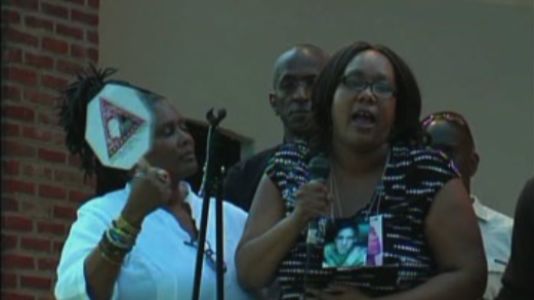
On Wednesday I went to a vigil in Harlem for Islan Nettles (pronounced [i’lan]). Earlier this month, a young man named Paris Wilson saw Nettles as an attractive woman and flirted with her. He then decided that she was “really a man” and felt humiliated in front of his friends. He attacked her, first verbally and then with his fists, hitting her until he smashed her skull. She died a few days later.

"This is not going to happen again… we're going to get some justice" -Delores Nettles
“this is not going to happen again… we’re going to get some justice”
-Delores Nettles. Image: NY1
It was important for me to go to that vigil. This is a danger that I face, as someone who may sometimes be seen as a man in a dress. As a white person who lives in Queens and goes out in Manhattan, my danger is much lower than those faced by nonwhite people who live and go out in poor neighborhoods, but I deserve better, and people like Islan Nettles deserve as much safety as I do.

I was moved to see Nettles’ mother, sister and uncle stand on stage and demand justice for their loved one, with the silent support of many other family members. I was gratified that politicians like Scott Stringer and Inez Dickens helped to get space in Jackie Robinson Park at such short notice, and then stood with us in the crowd instead of dominating the stage. I was glad to see lesbian and gay religious leaders call out their colleagues for their lack of support. I appreciated seeing nonwhite trans women like Chanel Lopez and Laverne Cox take the stage for justice and safety.

There were aspects of the event that concerned me. The event was run by relatively gender-conforming lesbians and gay men, who might not have been able to completely appreciate the specific dangers faced by black trans women like Nettles. There was an older queen who was presented as a friend of Nettles, but their relationship wasn’t entirely clear to me. Was she Nettles’ gay aunt? Or just an acquaintance?

Overall I came away heartened to see that many people coming together for justice and safety. I’ve occasionally worried, if I were murdered, how many people would care about some trans person? Seeing hundreds of people at this vigil was a bit reassuring.

There were a number of trans people in the audience who were heckling the stage. Some said, “Let the trans people speak!” Some corrected gender references made by people on stage, yelling “she!” when someone said “he,” and “woman!” when someone said “man.” This has become a major issue, and I’ll write about it soon, but I wanted to give some background first.

Something to bring people together

It was a moving experience this evening to attend the vigil for Islan Nettles, who was brutally murdered in Harlem on August 17. I fear for my own life sometimes, even though I know that the risk I take in being publicly transgender as a white person who’s seen as male most of the time is nothing compared to the risk to black and Latina trans women, who make up the vast majority of trans murder victims in the United States.

One speaker remarked on the hundreds of people gathered and said, “It shouldn’t take something like this to bring people together.” This resonated with a thought I had when I arrived in Jackie Robinson Park: when was the last time there was such a big gathering of LGBT people in Harlem? When was there such a large trans-friendly space there? When was there so much overt (if silent) official approval for a transgender event?

For years, people from Harlem have had to take the subway downtown to show their gay and trans sides. In 2013, with crime at historic lows, this should not be necessary. Harlem should be a place where trans people can be free to dress as we want, without being attacked.

The vigil was just a few blocks from where Nettles was beaten to death by Paris Wilson. It made me wonder whether Wilson and his friends would have felt quite so threatened by Nettles – and so confident in attacking her – if they saw more support for trans people from their community leaders. Would a regular, positive, trans-friendly event have made a difference, and could it make a difference in the future?

012-001
Then I looked over at my friend Brendan Fay who was standing nearby, and I realized I had proof that these positive events work. Fourteen years ago, Brendan got frustrated with the homophobes who refused to allow the Irish Lesbian and Gay Organization to march with a banner in the Fifth Avenue Saint Patrick’s Day Parade. He organized the first annual Saint Pat’s for All Parade in my neighborhood, and has been helping run it ever since. And it’s been bringing the neighborhood together.

Another friend and neighbor of mine is a devout Catholic, who saw the parade as an attack on Catholics. After he wrote a letter to a local newspaper a few years ago complaining about the parade, I spoke to him privately and told him that I’m a transvestite (yes, I used that word) and that when I moved to Woodside from the South Bronx I worried that I would feel just as unwelcome here as I did there. For me the parade changed all that. I saw all my neighbors, of all sexualities and genders, coming out to watch the parade, and I felt like they accepted me. I felt like I belonged.

I told my friend that I saw the parade as a celebration for the whole neighborhood, not just for LGBT people. I said that he and his friends would be welcome to march in it. He asked, “Could I march with a pro-life banner?” I thought that would be a little too divisive, and Brendan confirmed that it would be, but that Catholic organizations with unifying messages were welcome.

Recently, when I posted on Facebook that I was feeling frustrated with certain trans “community leaders,” my friend wrote this comment: “All I can state here is that you have done more to bridge the divide between trans people and the rest of society than any one I have known or met, turning people from prejudice to understanding of the complex issues involved, so rather than be upset at you, I hope praise will be in the offering.” High praise indeed, but I had help from Brendan and everyone else who organized the parade.

This year, in the supermarket, on the day of the parade another neighbor made a comment about “them” getting married, and I told her that I was a transvestite, and that much the parade made me feel welcome. Her face changed, and she answered, “As well you should!”

I hope that Harlem can learn from the successes that Brendan and I have had in Woodside. I hope they can have positive events that bring the community together: trans and non-trans; gay, lesbian, bisexual and straight. I hope that community leaders (and that includes religious leaders, and not just the LGBT ones who were a strong presence at this vigil) can take part and bring people together. We all deserve to feel safer, and black people deserve to feel as safe as anyone else.

Anybody but Christine Quinn for Mayor

Some trans activists fight for easy name and gender changes on official documents. Some fight for access to responsible, professional medical care, or for hormones and surgery to be covered by insurance or government programs. My main goal is for us to have access to bathrooms and changing spaces without getting the shit beaten out of us. And that’s why I’m asking you not to vote for Christine Quinn for Mayor of New York City.

A trans woman walks into a McDonald’s and asks to use the women’s bathroom. While she’s in there, someone yells at her “I’m going to kill you, faggot.” She goes out of the bathroom, and discovers that it was the store manager yelling at her, and he hits her with a lead pipe. One of her friends calls the police, but when they come they arrest the trans woman instead, on accusations from the store manager.

Maybe this sounds like something that happens in Texas, or Wyoming, but in 2006 a woman, Christina Sforza, claimed that it happened to her right here in New York City, across from the Empire State Building, in the City Council district of Christine Quinn. Trans community leaders and Amnesty International took the story seriously.

The Sylvia Rivera Law Project put out an alert on October 11, 2006, and I contacted Quinn shortly after that. She did not have a public email address, so I contacted her through a form on her Council website. I got no response for two weeks, until I got a broadcast email from Quinn’s office about a New Jersey Supreme Court decision on gay marriage. Frustrated, I replied to that email, only to get an auto-reply telling me to fill out the form. I filled out the form again, and got an email from Quinn’s chief of staff saying, “I would love to hear more so that I could have a staff member work with you.” Encouraged, I wrote back with more details.

The Amnesty report says, “Christine Quinn, New York City Council Speaker, reportedly intervened in October 2006 and Christina Sforza was finally able to file a criminal complaint.” I don’t know what this intervention is, but apparently nothing has come of it.

Since then, I have heard nothing from Quinn’s office on this issue. I have, however, gotten regular email updates:

  • 1 criticizing the arrests of “young transgender individuals” in the Port Authority bus terminal bathrooms
  • 1 supporting birth certificate gender changes
  • 1 supporting streamlining transgender marriage bureaucracy
  • 1 inviting me to a “Trans Reality Panel” sponsored by the Empire State Pride Agenda
  • 1 supporting GENDA, the state Gender Non-Discrimination Act
  • 8 annual invitations to the Council LGBT Pride ceremony
  • 1 inviting me to my neighborhood LGBT-inclusive Saint Patrick’s Day parade
  • 3 on hate crimes attacks on gay men
  • 1 on free self-defense trainings
  • 5 on Hurricane Sandy (including 1 on a “LGBT Day of Action” for Sandy victims)
  • 1 inviting me to a hearing on the experiences of LGBTQ youth in the juvenile justice system
  • 1 praising a speech by Hilary Clinton on LGBT rights
  • 1 on a LGBT Advisory Committee to the NYPD
  • 1 on LGBT rights in Uganda
  • 1 on LGBT rights in Russia

Every so often over the past seven years, I’ve tried to think of some reason for Quinn’s silence on this issue. Did her staff find some reason to doubt Sforza’s story? Was there something else that made Sforza a difficult victim to champion?

It doesn’t matter. We’ve heard Sforza’s story, and we know that trans people do get attacked in bathrooms – as we saw on video in Maryland in 2011.

I was deeply unsettled to hear Sforza’s story. It could have been me. I’ve been in that McDonald’s. When we hear reports of a horrific attack that could have happened to us, we want to know that justice is being done. Even if someone found out that Sforza made up the whole thing, it would still have been very reassuring to have a statement from McDonald’s that that kind of behavior is not tolerated from their employees. I would feel much better to hear from the NYPD that they take our rights seriously and will protect us if someone tries to punish us for peeing.

I would like to know that someone on Quinn’s staff took my safety in her district as seriously as they do someone’s birth certificate or marriage license, or the rights of people on the other side of the world. All the ceremonies and parades are meaningless if we can’t use the bathroom without the fear of being beaten.

When Quinn was first elected I was excited at the news of our first out lesbian city council member. I knew she cared about lesbian rights, and I hoped that that would carry over to transgender rights. I was disappointed.

This is why I will not vote for Christine Quinn if I see her name on a ballot, and why I’m asking you to vote for anybody but her on September 10. We can do better.

Breaking down the binary/non-binary binary

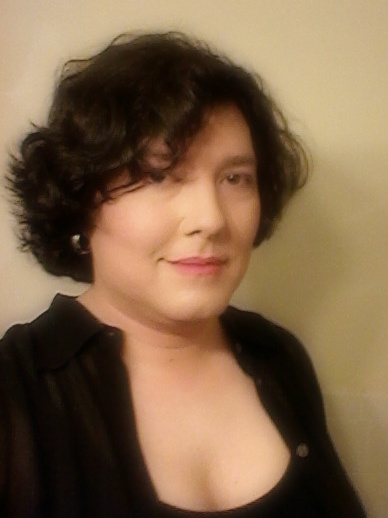
Side-by-side close-up images of the author presenting as feminine and masculine.

Sometimes I’ll ask self-appointed trans “community leaders” – who act like they’re speaking for all trans people – to let the world know that non-transitioners exist, and we have needs, and they’ll bust out something like, “oh yes, and nonbinary people too!” (Last year it was “genderqueer people too!” Sometimes now they add “genderfluid.”) It makes me feel like Elwood Blues when the bartender tells him, “We’ve got both kinds! We’ve got Country and Western!”

screenlg3

The thing is, I’m not really nonbinary – at least not in the sense that “my spirit truly lies somewhere in between,” as B. Scott so eloquently put it. My ideas of “guy” and “woman” are fairly non-traditional: I’m a guy who cries and cooks and earns less than my wife and stays home with the kid. When I want to be a woman, I want to be a smart, thoughtful woman.

But I don’t want to be in between. Not that there’s anything wrong with that! It just doesn’t capture how I personally feel about myself. I want to be a guy, except when I want to be a woman. I want to look like a woman, except when I want to look like a guy.

Do I look non-binary to you?

I’m not genderqueer: my performance of either gender is not intended to provoke or challenge. I’m not agender. I’m not a “closeted trans woman” in ciscritical-not-cisphobic’s attempt to pigeonhole us. I’m not a member of a “third sex,” and I don’t want to be. And no, “genderfluid” doesn’t work for me, either. (Updated 2020: I’ve made my peace with “genderfluid.”)

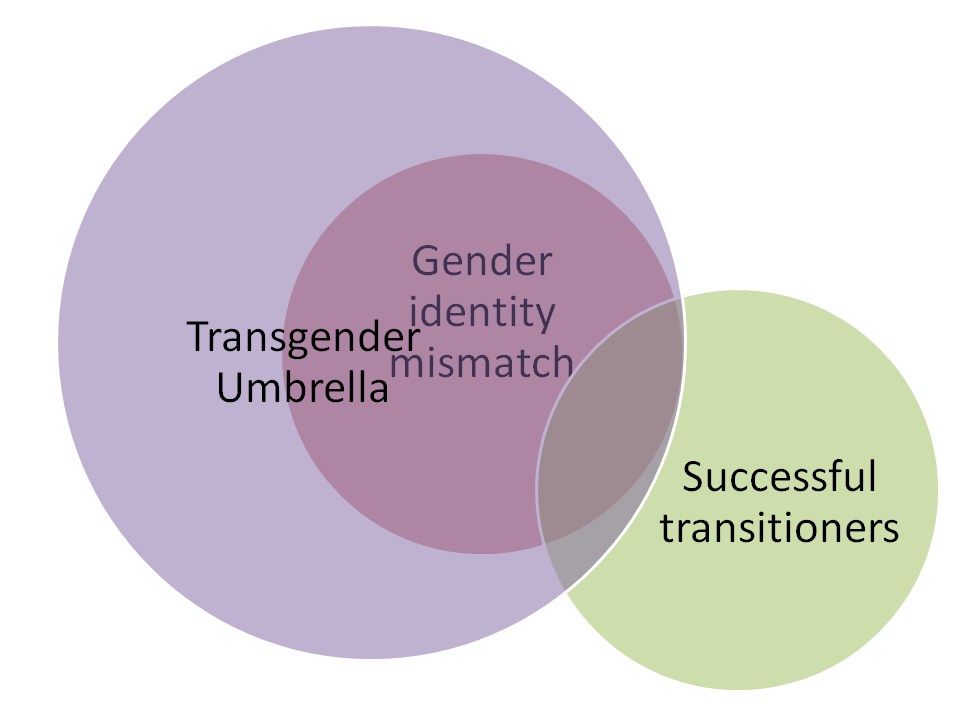
I am transgender. I have the same feelings and beliefs as a lot of trans people who have successfully transitioned. There is one difference: I chose not to transition. Trans, but not transitioning. Why can’t they say that?

Hands off my umbrella!

I was first referred to Monica Roberts for her explanations of why RuPaul doesn’t count as trans. A few months later I asked a gay black man about trans self-identification in black communities, and he pointed me to Roberts.

I was, honestly, more convinced by the assertion (I don’t know if it’s true or not) that RuPaul rejects the term “transgender” for himself. Whether or not he counts as trans, I think Roberts made a strong case that he is not a prototypical black trans person, or an appropriate community spokesperson. It seems like she wasn’t content with that, and insisted on excluding RuPaul completely from the category of trans. She has now taken it upon herself to do the same for another person who is not even claiming to speak for trans people, B. Scott.

bscott
I first heard of Scott last night when someone reposted a blog post of his on Tumblr; apparently he’s an entertainment journalist who does news, commentary and interviews on his blog, as well as a YouTube channel and podcast, but has branched out into more established media.

Scott identifies as a “proud gay man,” but his public persona is so high-glam femme that he is often perceived as a beautiful woman. At least one man felt embarrassed after trying to flirt with Scott, and lashed out in an immature way.

The current controversy started in June when Scott had been invited to appear at the 2013 BET Awards Pre-Show. He claims that at the last minute, after extensive wardrobe negotiations (people do this?) and interviewing one guest on camera, the BET staffers told him his outfit “wasn’t acceptable,” ordered him to change, and then told him he was being replaced for the rest of the pre-show.

Scott is now suing the network for “discrimination on the basis of gender identity, gender expression and sexual orientation.” In yesterday’s blog post, he wrote,

Over the years my love muffins and strangers alike have questioned me about my gender identity. What IS B. Scott? As a society we’ve been conditioned to believe that a person has to be ‘exactly’ this or ‘exactly’ that. Biologically, I am male — as my sex was determined at birth by my reproductive organs.

However, my spirit truly lies somewhere in between. It is that same spirit that has allowed me to become so comfortable in my skin, choose how I express myself, and contributes to how I live my day-to-day life.

Transgender is the state of one’s gender identity (self-identification as woman, man, neither or both) not matching one’s assigned sex (identification by others as male, female or intersex based on physical/genetic sex). [source]

It is by that definition that I accept and welcome the ‘transgender’ label with open arms.

Makes sense, right? Scott self-identifies as “somewhere in between,” which counts as “neither or both,” and doesn’t match his assigned male sex. But that’s not enough for Monica Roberts:

Roberts’ reaction is really problematic. What bothers me the most is that she is prescribing and delineating appropriate transgender actions. It’s not enough for Scott to appear in heavy makeup, long hair and women’s clothes and shoes every time he is in front of a camera. He has to take hormones, declare a transition, and adopt a name that Roberts approves as feminine enough.
tg definitions1
As I wrote back in April, there are at least three conflicting definitions of transgender. Roberts is saying that in order for her to consider him trans, Scott has to follow her prescriptions.

Another thing that bothers me is that Roberts is not only claiming the right to define transgender, but the right to define the umbrella. The “umbrella” definition of transgender is an inclusive one that brings in drag queens and anyone else who’s remotely gender-variant. As umbrella proponent Jamison Green famously said, “There is NOT one way to be trans.” Many prescriptive trans advocates explicitly reject the umbrella, many (like GLAAD) switch between the umbrella and their prescriptions, but Roberts claims that the umbrella is her prescriptions.

In a subsequent blog post, Roberts clarified that she worried that this identification was purely a legal strategy, and that Scott was only “embracing the transgender umbrella after resisting it for years.” “Until I get and see more evidence that B.Scott’s embrace of the transgender umbrella is genuine, permanent and not just related to this legal case, call me skeptical.”

Roberts knows a lot more about American black culture’s attitudes towards transness than I do, but I would be surprised if a gay black man who grooms himself like a woman and is often perceived as a woman would face very much less discrimination and harassment than a transitioning black trans woman. How often is Scott really able to draw on his male privilege?

Based on her reactions to RuPaul, my guess is that Roberts is worried that with his large following, Scott could emerge as a powerful trans leader and spokesperson without transitioning, eclipsing her own influence and those of other transitioned black trans people like Janet Mock* and Laverne Cox. Personally, I would welcome an influential non-transitioning trans person of any race to the cause. Any creative responses to trans feelings would be a relief from the relentless hormones-surgery-name-change drumbeat put out by Roberts, Mock and other trans spokespeople. And the transition buy-in that Roberts values so much doesn’t stop her from being divisive and exclusionary.

But regardless of whether you trust Scott to be true to the trans community, Roberts’ heavy-handed prescriptivism should alarm not just advocates of transgender inclusivity, but also feminists of all stripes. And her claiming the right to not just define transgender but to take the transgender umbrella away from us is just uncalled for.

(*Update: In this sympathetic interview, Janet Mock makes it clear that she’s not into that kind of boundary policing.)

What’s keeping me awake at night

I have real reasons to be happy about my excursion on Saturday. I have a great friend. My co-workers are super cool. But that’s not how gender fog works with me. Instead, it keeps me up all night thinking about things like this:

I'm so hot.
I’m so hot. Don’t you think I’m hot? I’m in soft focus.
  • I’ve lost so much weight! I wonder if I’m a 38C or a 36D.
  • That guy who held the door for me totally didn’t read me. I bet nobody did!
  • I definitely fit in with all those cute tourist women. I was prettier than a lot of them.
  • I could rock the dress that woman was wearing on the subway yesterday.
  • Would the brown skirt I bought go better with a black top or a white one?
  • I so want to go out in that green dress. Maybe this weekend. Can I get the time off?
  • Makeup is such a pain. I wonder how much laser costs.
  • Can I really wear a strappy sundress? I’d definitely need to get rid of my T-shirt tan lines first.
  • I could have gone to work in a dress yesterday. No, maybe that wouldn’t be a good idea. Well, at least I could’ve gone to the coffee shop in a dress. Who cares what my neighbors think?
  • Is my video camera good enough to make a haul video?