Everything you really wanted to know about trans people

dogma
A number of my trans friends and non-trans allies have been tweeting and reblogging last week’s BuzzFeed post by Sarah Kasulke and Chris Ritter, “Everything You Always Wanted To Know About Transgender People But Were Afraid To Ask,” with the subtitle, “It’s cool, we know you have questions.”

It’s been a struggle to explain exactly what bothers me so much about that piece. I’ve taken a stab at explaining the general problem with these two pages, A Skeptic’s Trans 101 and Before You Reblog, but I haven’t addressed the BuzzFeed post specifically.

The first problem with Kasulke’s post is that it’s not everything you always wanted to know about trans people but were afraid to ask. It’s just the latest version of the same old trans dogma dressed up as a Q&A. Here are some things she focuses on that are just not burning questions in people’s minds:

  • Should I say “transgender” or “transgendered”?
  • What do all these fancy words you keep using mean?
  • Am I a horrible person for being skeptical of this true inside gender you claim?
  • I haven’t heard nearly enough about hormones from trans people. Please tell me more!
  • There are genders besides boy or girl?
  • Are drag queens transgender?
  • Should I use the pronouns you clearly want to hear, or the ones I want to say?
  • Do people ever get upset when someone calls them “it”?
  • Should I call trans people shemales?

No, the things that everyone always wants to know about trans people are more like this:

  • Are you a man or a woman?
  • So you’re gay?
  • Have you had the surgery?
  • What happens during the surgery?
  • How do you have sex?
  • Are those real?
  • How do you hide it?
  • Why would you do this to yourself?
  • Isn’t there some kind of therapy for this?
  • Can’t you just be a butch lesbian?
  • What does your mom think?
  • What do your kids call you?
  • Is your wife really okay with it?
  • Can I have sex with you? Not because I like you, but just to satisfy my own curiosity and then move on to a real woman?

and yes:

  • What is your real name?

I’m not saying that anyone deserves answers to these questions. But the genius of David Reuben’s original book Everything You Always Wanted to Know About Sex (but Were Afraid to Ask) is that it took a topic where there was so much shame and prudery, chose questions that were actually in people’s minds, and answered them without moralizing. It was a breath of fresh air after the tedium and taboo of what had passed for sex education before.

Kasulke and Ritter’s piece reads more like the books that Reuben was reacting to. It’s full of moralizing, shame and taboo. If someone’s afraid to ask “what’s your real name?” how are they going to feel after reading Ritter’s slide? Despite Kasulke’s subtitle, she clearly doesn’t think it’s cool to have questions like that, and she’s not going to answer them.

I’ll tell you what: I’ll answer your questions. If you read my Skeptic’s Trans 101 and still have questions, poke around on the site a bit. If you still have questions, email me. And if you see a post like Kasulke and Ritter’s, please check my list before you forward it.

Update: Two weeks after I posted this response, Kasulke (now Calvin Kasulke) posted “17 Questions Trans People Are Tired of Hearing.” I don’t know how much BuzzFeed paid him, but I’m still waiting for my cut.

Gender fog

You may have heard about “gender fog.” Also known as “pink fog,” “pink cloud” or “gender euphoria,” it’s an intense emotion that many transgender people experience around a significant event. I used to get it when I tried on a new outfit, particularly a kind that I had fantasized about (when I was a teenager, that involved short skirts and nylons). Now it mostly happens when I go out in public presenting as a woman.
SAMSUNG
This excitement is relative, and it depends on how much I’m used to the activity. If I haven’t cross-dressed at all in months, I may feel some gender fog just at cross-dressing. The same thing for shaving or haircuts, or new outfits. If I’ve been cross-dressing a lot, and shaving and maybe even getting new outfits on a regular basis, I don’t get as excited. Since I haven’t been going out cross-dressed very much lately, just going out can bring on very intense euphoria.

For me, gender fog generally starts as soon as I make plans to go out. I get insomnia, where instead of sleeping I lie in bed thinking about what I’m going to wear, where I’m going to change, whether I’m going to meet up with anyone, when I’m going to leave, where I’m going to shop and what I’m going to buy, whether I’ll have a meal, and so forth. I dwell on potential problems, mostly around passing: is my makeup technique good enough to cover my beard? Is my belly too big? Are my shoulders too broad? Will it be too hot to wear a dress that flatters my figure? Have I been practicing my voice enough? Will my sinuses be clear enough?

When I finish changing and actually go out in public, I usually get very excited. Then, since whatever activity I do in public lasts several hours (otherwise it’s not really worth putting on all the makeup), at some point in the day or evening I’ll feel kind of tired or bored, and think, “I could be doing this in guy clothes, and it’d be a lot easier.” But then there will usually be something else interesting or fun that happens. I’m typically tired at the end of the trip, and sometimes I sleep very well for several nights afterwards.

The post-event gender fog usually involves some experience that made me happy, usually because it confirms my role as a woman. Because of this, many of these involve passing or acceptance. I got a cute outfit. I used my female voice for the first time. A guard directed me to the women’s room in Rockefeller Center. A waiter flirted with me. A transitioned trans woman briefly thought I was a non-trans woman. A woman complimented my look. I went to an interesting part of the city or event that I’d never been to as a woman. Or maybe it was just the experience of walking through the city, being accepted as one of the women.

After the experience, I find myself dwelling on it, thinking about how I could repeat or extend it. If I got a cute outfit, I think about wearing it at home, or on a future outing. Maybe I think about future outfits. If it’s an interaction, I think about other interactions. If it’s a place, I think about going back to that place, or to other places. I also may think about things that were time-consuming or inconvenient, and about ways that I could make them easier.

If I had a really good time or if I did something really new for me, I may be high for days, thinking about nothing but my experience. My wife and friends get really tired of hearing about it. I have trouble concentrating at work. I may plan to go out again, sooner than I had originally thought. I may think about more “soft body mods,” like ear piercing, growing my hair or permanent leg or facial hair removal.

The gender fog always lasts for several days after the event. Usually I use ten days as a rule of thumb, although if I ever go out more than once in a ten-day period the excitement is compounded.

Yesterday I went out in public, and I’m definitely feeling the gender fog. It’s not as intense as it has been at some times. I had trouble sleeping the night before, and I was expecting to sleep better last night, but I had similar difficulties. On the other hand, my difficulty sleeping may be unrelated to this experience. I’ve been having insomnia lately anyway, and the heat doesn’t help.

Some of you may be scoffing at this. If you transitioned years ago and have been living a quiet life as your target gender, then yes you probably don’t have experiences like this. Similarly if you’ve got a stable genderqueer or genderfluid existence. If you’re transitioning then your outings are probably more extensive, frequent and social than my shopping trips. But I’ve seen transitioners have similar reactions to other milestones, particularly relating to hormonal body modifications and legal and social acceptance. I’m guessing that you’ve all had some feeling like this.

A Skeptic’s Transgender 101

How we use gender:

  1. Every society we know of assigns people to genders.  Usually this is “man” or “woman,” depending on the way their genitals look at birth.  Some societies have a third gender that involves a combination of the roles of the male and female genders.
  2. Most people have the habit of classifying everyone they meet into one gender or another. Often this is reflected in aspects of language such as pronouns.  Some languages, like French, even assign gender to inanimate objects.
  3. Every society we know of reserves certain roles, spaces and relationships for the exclusive use of one gender or the other, such as jobs, bathrooms and marriages.  In these situations, gender is always a shortcut for some harder-to measure criterion, like strength or the ability to bear children.
  4. Every society we know of has gender expression: ways that people identify themselves as one gender or another.  Some of these are behavioral, involving habits of speaking or moving.  Others involve clothing, accessories and grooming.

How we react to gender:

  1. Everyone has feelings about their gender.  Many people have transgender feelings: a desire to be a gender different from the one assigned to them.  Many people have gender dysphoria: discomfort with the gender they were assigned.
  2. Everyone has beliefs about their own gender.  Some people have transgender beliefs that conflict with the gender they were assigned.
  3. Some people take transgender actions: they are assigned to one gender but take on expressions, spaces and roles that their culture reserves for another gender.  These gender expressions may include modifying their bodies in various ways.

How to respect gender:

  1. You will meet people who have strong feelings about their gender.  Be sympathetic.
  2. You will meet people whose beliefs about their gender differ from yours.  Respect their beliefs, and expect that they will respect yours.
  3. You will meet people who express gender differently from the way you expect. Respect them.
  4. You will meet people who want you to address and refer to them as a different gender than you might otherwise.  Honor their desire. It’s just words.
  5. You will meet people who you would normally assign to one gender, but who want to take on roles and spaces that your society reserves for a different gender.  Respect their wishes and accommodate them as much as possible.

How to help:

  1. We hear lots of nasty things about people who violate gender norms. Say a few nice things.
  2. Some people attack people who violate gender norms. Protect people from these attacks.
  3. Some people discriminate against people who violate gender norms. Help balance that out.
  4. Some people spin myths about transgender feelings, thoughts and actions. Some of the most destructive myths are spun by people who are trying to help. Be skeptical, while still being respectful.

How to be skeptical while still being respectful:

  1. Your beliefs – about gender and everything else – are your own. Don’t let anyone tell you what to believe.
  2. There’s a big diversity of gender feelings, beliefs and actions out there. A story about a single person won’t tell you about everyone.
  3. We don’t hold elections. Anyone who claims to speak on behalf of “the trans community” is lying.
  4. Lots of people hide their trans beliefs, feelings and actions. We don’t know about them. Anything about transgender issues that contains “most,” “all” or any percentage is probably wrong.
  5. Brain science is not at a point where it can tell us anything reliable. Anything about transgender issues that talks about specific parts of the brain is probably wrong.
  6. Most people desperately want to be normal, and are willing to lie to themselves and everyone else to feel normal. Anything that makes anyone look normal is probably wrong.

Bad stats, advocacy and HIV in trans communities

In April I posted about a study by Stefan Baral and his colleagues at Johns Hopkins that purported to show that “Transgender Women 49 Times More Likely to Have HIV.” Baral acknowledged in a comment (I have no reason to doubt that it’s really him) that “these are pretty bad stats!” but went on to say that he felt his publication would help trans communities in the long run, and pasted the limitations section that he had ignored in his statements to the Huffington Post.

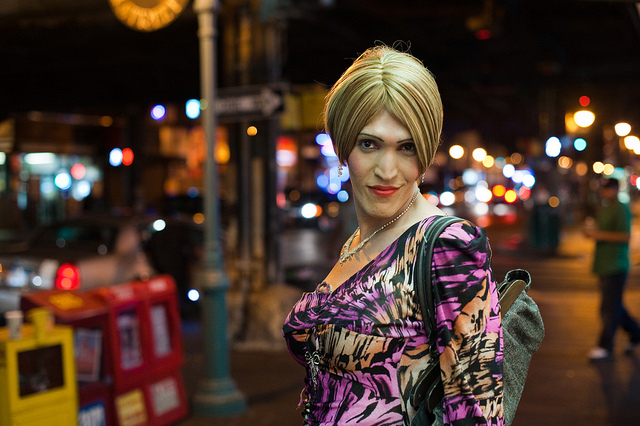
Claudia says that the police in Jackson Heights are much more respectful than in Hunts Point, focusing on keeping the overall area safe. “The men get rowdy, get drunk, and behave awfully. I don’t care if these women are men, nobody has a right to treat them like garbage.” See more photos by Chris Arnade, and read some of the sex workers' own stories.
Claudia says that the police in Jackson Heights are much more respectful than in Hunts Point, focusing on keeping the overall area safe. “The men get rowdy, get drunk, and behave awfully. I don’t care if these women are men, nobody has a right to treat them like garbage.” See more photos by Chris Arnade in his Flickr set, and read some of the sex workers’ own stories.

In theory I agree that it’s worth disseminating potentially inaccurate information if you believe that it’s going to help people regardless. In practice it’s never easy to predict what effect your actions will have. In this particular case, I think that reports like these do more harm than good for a very specific reason: they obscure important differences.

Baral’s study was actually a “meta-study” that combined studies done in cities all over the world. All of these studies investigated non-random samples of transgender people, usually focusing on subgroups that are at particular risk for violence or disease. They all include disclaimers saying “NON-REPRESENTATIVE SAMPLE NO NO DO NOT GENERALIZE RESULTS!!!”

One of the source studies turned out to be the study that I participated in here in New York, led by Larry Nuttbrock of the National Development and Research Institutes (NDRI). In November I criticized the study for overgeneralizing, but as I mentioned in May, the study does reveal some important things, which may very well be found in other communities.

In particular, the NDRI study reveals the deep divide here in New York between the lives of middle-class white trans people and lower-class black and Hispanic trans people. The difference in HIV infection rates (3.5% vs. 48-50%) between the two groups of participants in the study is huge. In another paper, the NDRI researchers indicate that HIV infection tends to correlate with unprotected anal sex, which in turn tends to correlate with gender abuse and symptoms of depression, as well as with attraction to men and nonwhite ethnicity.

What that means, in turn, is that middle-class white trans people like me are not at significant risk for HIV infection, or gender abuse, or depression. To use a fancy social science term, it’s intersectional: if you’re black or Latina, if you’re feminine, if you’re attracted to men, if you’re poor, if you’re a prostitute, it all adds to your risk. And as Hwahng and Nuttbrock observed, it’s all about power: the power to say no to unprotected anal sex.

That’s why you won’t see me using this study to get anything for myself. These high HIV rates don’t apply to me. I don’t deserve any of the money that governments and donors want to spend on it. I don’t know which donors Baral is trying to convince, or what he wants them to spend the money on, but it shouldn’t be middle-class white people.

This is not a problem of “trans women” or even of transgender people in general. It is a problem of disempowered black and Latina transvestites, and it can only be solved by re-empowering them. As Erica so eloquently put it, nihil de nobis sine nobis.

Of course I’m concerned about these high HIV rates, because I care about my fellow transvestites, and my neighbors. That’s why I’m prepared to act in support and solidarity, and I hope you are too. But don’t talk to mainstream transgender organizations that aren’t doing anything about this issue. Talk to organizations that empower sex workers of all genders, like the Red Umbrella Project.

Were you looking at the woman in the red dress?

Film director Lana Wachowski, whom I associate most with the Matrix, has now declared her gender transition. I didn’t feel comfortable speculating when her transgender feelings were just a rumor, but now I can say that I see the Matrix as a deeply transgender movie. Blogger Hannah DuVoix finds a number of trans themes in the movie, but dissociation and glamour are the two that make the biggest impression on me. (There will be some spoilers here for those who haven’t yet seen it.)

The Matrix is dissociative. Dissociation is a psychological term for a particular kind of disconnect from reality, at least as others experience that reality. Dissociation can range from plain old field-independence to a deeply held belief that “my” body is not my own. One of its most extreme expressions is the dissociative fugue, where a person runs away and assumes a new identity, sometimes forgetting who they “really” are.

I refuse to speak for all trans people, but my own trans feelings have always contained an element of dissociation, and I’ve seen and heard it from others. A lot of my trans fantasies have involved some disconnection from my body. When I was younger I used to fantasize about moving to a different city and taking on a completely new identity for myself. Many trans people have done this, including the story of Holly Woodlawn as Lou Reed tells it in “Take a Walk on the Wild Side.”

In the Matrix, these dissociative fantasies are reality. When Neo takes the red pill, his entire reality is revealed to be an illusion, and he discovers his real body and the sensations that go with it. He is not just a programmer, “Mr. Anderson,” in a dreary world. He is something more, something where his “unreal” online identity is foregrounded.

113The_Woman_in_Red-med
The Matrix deals with glamour, and specifically the desire to own and control feminine glamour. After Neo first disconnects from the Matrix, Morpheus takes him into a training program, a sandbox where he can demonstrate how the constructed world works. He is distracted by “the woman in the red dress” (played by Fiona Johnson), who walks by, smirking flirtatiously, and then turns into an evil Agent pointing a gun at Neo.

When Neo leaves the training program, his new shipmate Mouse slyly confides that he created the woman in the red dress, and that she’s available for other encounters. It’s not exactly a secret that many trans people obsess over the glamour of their target gender, trying to discover and replicate its secrets.

In her speech to the Human Rights Campaign, Wachowski talks about spending hours trying on dresses in the wardrobe closet of her high school drama club. I have similar memories, and when I saw the Matrix I had spent the previous year and a half working on my own animated virtual women, one of whom was sort of blonde (and neither of whom turned out anywhere near as sexy as the Woman in the Red Dress). Like Mouse – and Wachowski – I had very good reasons for doing it, but those reasons don’t preclude others.

Again, I’m not saying that all trans people are dissociative or obsessed with the glamour of their target gender, but these are themes we hear from lots of trans people. I wasn’t entirely surprised with the rumors and later revelations about Wachowski, because I had recognized a kindred spirit.

“Trans women” and the erasure of transvestites

Transgender politics is notoriously full of terminological arguments. It’s an age-old expression of power: the right to decide which categories people get put in, who belongs and who doesn’t, who is condemned and who is spared, who is mocked and who is praised.

These arguments are compounded by the problems that we humans have in categorizing anything in a way that we can agree on. Last week I had a chance to talk with George Lakoff, who has done a lot to raise awareness of the problems with traditional definitions of categories, and he agreed that these problems have a greater impact when it comes to categorizing people.

Because of this, I generally try to avoid talking about transgender people, and instead focus on trans feelings, beliefs and actions. Unfortunately, the rest of the trans world hasn’t seen the value in this, and keeps arguing about how to categorize people. One of the worst things people do is to apply their categories uncritically to people from other cultures at other times, without their approval or consent.

This came up a few days ago when someone called Nat tweeted this:


As Nat explained to me, the target of this tweet was the organization Stonewall UK, which is apparently run by a bunch of rich white dudes in suits. I agree that it’s problematic for an organization called Stonewall to be run by people who don’t look anything like the people who started the Stonewall Riots, but I objected to Nat’s use of “trans women” to describe the actual rioters.

The people who started the Stonewall Riots did not call themselves “trans women of color.” “Trans women” is a recent coinage, from the past ten years, and “of color” is only slightly older. If they wanted to categorize themselves by race they were “black” (maybe “Negro”) and “Puerto Rican,” and if they categorized themselves by gender expression they were “transvestites” and “queens.” After the riots, the organization that Sylvia Rivera founded was called the Street Transvestites Action Network. (She later changed it to Street Transgender Action Network, but never to anything containing the term “trans women.”)

Rioters at the Stonewall Inn, 1969.
The problem with referring to the Stonewall activists as “trans women” is that that category is reserved for transitioners. Some of the Stonewall veterans had partly transitioned, and some transitioned later (including Rivera), but many lived part time and never transitioned. Would they transition if they were in their teens and twenties today? Maybe, maybe not.

Nat tweeted to me, “I was under the impression that trans* included -vestite?” Yes, trans* includes -vestite. “Trans woman” does not – except when they’re co-opting us to get money or political support.

When have you ever heard “trans woman” used to describe someone who’s not transitioning? RuPaul has been explicitly excluded from the category – and apart from being wealthy she probably bears the greatest resemblance to the Stonewall rioters of any celebrity today. If you can find a non-transitioner in any list of contemporary “trans women,” I’d love to see it. I’ve never seen Eddie Izzard or Rye Silverman in one. And in the few tweets I’ve read from @theNatFantastic, I’ve never seen a contemporary non-transitioner as a trans woman.

So no, you don’t get to go around talking about “trans women” never mentioning a non-transitioner, and then turn around and claim non-transitioning heroes as “trans women.” The Stonewall rioters were not trans women. They were transvestites. They’re my heroes, not yours.

Here’s the kicker, which prompted Nat to tell me to “chill the fuck out”: there is a systematic exclusion of non-transitioners from the “trans community,” and “trans women” leaders are actively involved in this exclusion. “Trans women” are doing exactly the same thing as Nat’s “rich white dudes in suits.” Nat’s tweet was part of this exclusion.

Maybe it’s because I sometimes look like a white dude in a suit, but I’ve found a lot more acceptance and support from rich white dudes in suits than I ever have from “trans women,” many of whom are rich and white and wear suits.

Let’s all remember that the Stonewall Riots were started by Black and Puerto Rican transvestites. Their legacy belongs to the world, but more to Black people, Puerto Ricans and transvestites than to the rest of us. And most of all to Black and Puerto Rican transvestites, who still flock to Greenwich Village to this day. Maybe we should let them decide what to do with it.

Segregated bathrooms are a kludge

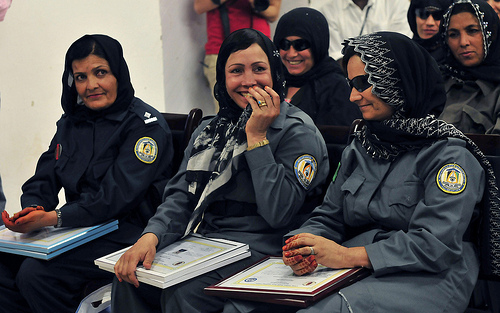
Bathrooms are an important issue to me. When I present as a woman I use women’s bathrooms, and I want every trans person to have the right to choose their bathroom. But I realize that the desire some people have to exclude us from bathrooms is based on a legitimate concern. I heard this recently in a story from Afghanistan, where some people have made gender-segregated bathrooms a priority.

Graduates of the Women’s Afghan National Police training course in Kandahar province, Afghanistan smile after receiving their ANP graduation certificates Aug. 5 at Camp Nathan Smith. Photo by Spc. Tracy R. Weeden / Isafmedia.

In Afghanistan, crimes against women often go unpunished. The Afghan government recognized that a major factor was the absence of female officers, and hired a number of new recruits. Now, many of those police officers are leaving, because they are being regularly attacked and raped.

The most common locations for these assaults are the police station bathrooms, which are open to all genders. The female officers are most vulnerable when half-naked, performing involuntary bodily functions. The proposed solution, advocated by Human Rights Watch, is to institute women-only spaces, where a man would be automatically suspect.

It’s too often overlooked that the shared bathrooms in no way cause the attacks. These attacks are deliberate acts of violence chosen by individuals, encouraged by a culture that dehumanizes women, and perpetuated by a legal system uninterested in bringing the perpetrators to justice.

This story helps some of us understand why gender-segregated bathrooms exist in the first place. They are a kludge, a short cut to stop the worst abuses. And like all kludges, bathroom segregation doesn’t work one hundred percent. There are false positives – trans people who are denied access to the bathrooms that fit our presentation and marked when we use the others. Significantly, there are plenty of false negatives – men who walk right into segregated bathrooms and attack women without any claim to transgender status.

A kludge may be necessary to break through a logjam. Think of the US Marshals who accompanied Ruby Bridges when she became the first Black student to attend William Frantz Elementary School. Segregated bathrooms may similarly be warranted in the case of the Afghan police. But just as integrated schools no longer require guards for every Black student, in some places segregated bathrooms may no longer be necessary.

Twice when I was in college here in the US I lived on dormitory floors where the bathrooms were nominally reserved for a single gender, but the residents had voted unanimously to open them to all genders. When I was studying in Paris, the public bathrooms in the classroom buildings were similarly integrated, with all gender markings removed.

Of course rape and voyeurism still exist in both the US and France, and in some places it may still be necessary to segregate bathrooms by gender. But the two experiences I mentioned suggest that in some situations respect for women’s rights and the rule of law is so secure that we no longer need the kludge of segregated bathrooms to protect women.

Even in places where gender-segregated bathrooms are still deemed necessary, it is clear that people who want to rape, ogle or video women in bathrooms will do so if they think they can get away with it. A small minority of them claim to be trans, probably because they actually are trans. In the end, what really protects women in bathrooms is not ineffective attempts to keep trans people out of them, but strong enforcement of the laws against assault and voyeurism.

Living in the highlight reel

Steven Furtick, a Christian cleric who has publicly condemned homosexuality, has nevertheless come up with a great metaphor to help us understand insecurity.

Building on Furtick’s metaphor, it occurred to me recently that glamour, as described by Virginia Postrel, is the desire to escape from our behind-the-scenes into someone else’s highlight reel.

Headshot

After taking this picture of myself last week, I’m thinking that narcissism is the desire to escape from our behind-the-scenes into our own highlight reel.

Visibility fatigue

There’s a concept that I want to introduce here: visibility fatigue. It’s something I’ve been noticing in relation to trans issues, and I’ll make those connections in future blog posts.

I have a T-shirt that says, “MIND THE GAP” with the logo of the London Underground. I bought it on a trip to London in 2001, when a recording of that phrase was played every fifteen seconds or so in stations that had a particularly large gap. Back home in New York, one day I was out walking and a guy gave me a knowing look, smiled and said, “Nice shirt.”

It seemed like he wanted to talk more, like we shared some great secret, but I was on my way somewhere else and didn’t really want to chat about it. I realized at that moment that there’s probably thousands and thousands of people here in New York who’ve been to London, ridden the Underground and heard that phrase. Did we really share that much that separated us from other New Yorkers? At that moment I realized that I didn’t really want everyone I ran into on the street knowing I’d been to London.

I have another T-shirt that’s one of my prized possessions. I got it at the 1996 Pride Rally, one of the first times I ever went out in public presenting as a woman. One day I wore it to the gym around the block, and on the way there I happened to be walking alongside my neighbor Jim. Jim asked me why I was wearing a big pink triangle if I’m married to a woman and we have a kid together. I explained that I was a transvestite and answered a few more questions, and everything was cool.

Most of the time, though, the shirt just sits on the shelf. It’s not that I don’t want to be out, proud and visible. It’s that I want some measure of control over it. It was work explaining this stuff to Jim, and there was no guarantee that he would be as understanding as he was about it. Sometimes I’m not up for that.

At the Lavender Languages conference this year I attended a talk by the Moroccan-French-Canadian artist 2fik who does amazing and very provocative things with gender and identity. He described some very hostile reactions he’s gotten – including death threats in at least one instance. But as I remarked to him, at the end of the day he can take off his clothes. He can have a break from being provocative.

I’ve always wanted to keep that ability to have a break. I grew up a long-haired boy in the seventies, and I remember that visibility fatigue – just wanting to blend in once in a while. It figured into my decision not to transition: I had succeeded in being seen as a pretty young woman, and enjoyed that visibility in small doses, but understood why so many women find it frustrating. I had also had the experience of not passing, and attracting attention that way. I knew that most people have times during a transition when they don’t pass, and some never pass. I didn’t want to be that visible all the time, with no rest in anonymity.

My tolerance for visibility has also varied over the course of my life. When I was younger I often felt a desire to be provocative. Now I favor more subtle approaches. I think that’s natural and good. But I’m glad that I didn’t make choices when I was young that don’t work for me now.

Some people have a lower tolerance for visibility and attention than I do. Others, like my neighbor “La Loca,” have a greater tolerance. If they want to use that visibility to teach people or just express their gender in a way that feels more comfortable, more power to them. Especially if they don’t wind up committing to a level of visibility that they can’t sustain with comfort later on.

In future posts I’ll show why I think visibility fatigue is important when talking about transgender lives.

Good research: Three trans communities in New York City

In November I was annoyed with a couple of statements by Sel Hwahng, but after re-reading this article he co-authored with Larry Nuttbrock, I’ve decided that it’s really solid research and should be read by anyone who’s interested in public health – or trans politics in general.

nihms-43568-f0009
The Silver Swan, a popular hangout for “White cross-dressers” in the mid-00s.

As I discussed in my earlier post, several years ago I participated in a study where I went to a storefront every month or so, gave a blood sample, and talked with a researcher for a while. Usually it was a fairly repetitive series of short-answer or Likert questions, but there were a few discussions that were more open-ended. Larry Nuttbrock was the principal investigator on the study, and I’m one of the “White cross-dressers” that he and Hwahng are talking about.

Re-reading the article, I see that it was really only two lines that bothered me:

These cross-dressers explained that because of their desire to maintain a traditional masculine gender role and hide their transgender status, they often did not undergo transition, hormonal supplementation, or surgery until well into their 40s or 50s. Transition often occurred after a domestic breakup, when they could be more out as transgender.

It was definitely true that some of us really wanted to transition but felt trapped by commitments to work and family, but not all of us by any means. I personally decided that I didn’t want to transition years before I got married and had a child, and I haven’t changed my mind about it. Most of the other people I met in that scene showed no interest in transitioning. But this is relatively minor.

Judging from media reports and health research, you might think that the trans population is either all HIV-infected prostitutes or all sexy young transitioners. I schlepped down to Avenue A every month and got pricked with a needle so that people could see another way to be trans. Hwahng and Nuttbrock show that here in New York there are at least three ways to be trans. They found that life was very different for us White cross-dressers than for Asian sex workers and members of the House Ball community.

According to Hwahng and Nuttbrock, House Ball members, almost all from Black and Latin American backgrounds, were more likely to engage in survival sex work and to have little power to refuse sex or to insist on condoms. Members of my White cross-dresser community were largely able to avoid sex work if we chose, so “when White cross-dressers did engage in sex work, it was almost always for recreational purposes.” The Asian sex workers in the study had an intermediate level of power, often being able to insist on condoms and working in hotels and apartments instead of on the street.

Given these different circumstances, it’s sadly not surprising that our risks of HIV infection are vastly different. In another paper co-authored by the entire study team, they didn’t have enough data about the Asian sex workers, but they reported that “HIV was 3.5% among Caucasian Americans compared to 49.6% and 48.1% among the Hispanics and African Americans.”

It’s important to note here the limitations of the study. Nuttbrock and his colleagues were able to investigate these three trans communities, but they were aware of others:

The study also identified additional groups, including the following: low-income, immigrant Latina(o) sex workers of Central and South American origin who solicited in Queens; low income, immigrant Latina(o) sex workers who solicited in Manhattan; and low-income, immigrant South Asian transvestites in Manhattan, Queens, and New Jersey. Not enough data had been gathered at this writing, however, for detailed analyses of these other populations. Some study participants did not fit any of these ethnocultural contexts but did not constitute large numbers and were thus considered outlier data.

This is really key. We don’t know what we don’t know. There could be some population of wealthy South Asian transvestites that completely swamps all three of the other groups numerically, but that was invisible to Hwahng and Nuttbrock because they meet in secret in luxury condo towers. Not that likely, but nobody really knows. I’ll close with a great quote from the report:

To understand the complex, interlocking behavioral and sociostructural determinants of health that often remain hidden within the geographic location of the New York City metropolitan area, it is thus imperative to examine as many divergent ethnocultural transgender communities as possible.