More on the vigil for Islan Nettles

On Wednesday I went to a vigil in Harlem for Islan Nettles (pronounced [i’lan]). Earlier this month, a young man named Paris Wilson saw Nettles as an attractive woman and flirted with her. He then decided that she was “really a man” and felt humiliated in front of his friends. He attacked her, first verbally and then with his fists, hitting her until he smashed her skull. She died a few days later.

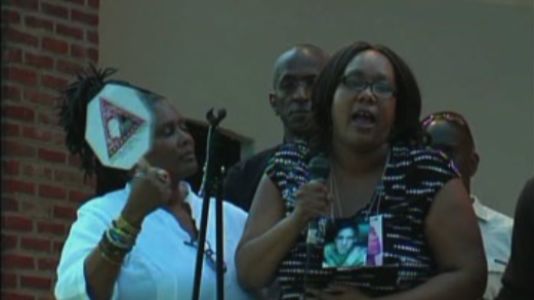
"This is not going to happen again… we're going to get some justice" -Delores Nettles
“this is not going to happen again… we’re going to get some justice”
-Delores Nettles. Image: NY1
It was important for me to go to that vigil. This is a danger that I face, as someone who may sometimes be seen as a man in a dress. As a white person who lives in Queens and goes out in Manhattan, my danger is much lower than those faced by nonwhite people who live and go out in poor neighborhoods, but I deserve better, and people like Islan Nettles deserve as much safety as I do.

I was moved to see Nettles’ mother, sister and uncle stand on stage and demand justice for their loved one, with the silent support of many other family members. I was gratified that politicians like Scott Stringer and Inez Dickens helped to get space in Jackie Robinson Park at such short notice, and then stood with us in the crowd instead of dominating the stage. I was glad to see lesbian and gay religious leaders call out their colleagues for their lack of support. I appreciated seeing nonwhite trans women like Chanel Lopez and Laverne Cox take the stage for justice and safety.

There were aspects of the event that concerned me. The event was run by relatively gender-conforming lesbians and gay men, who might not have been able to completely appreciate the specific dangers faced by black trans women like Nettles. There was an older queen who was presented as a friend of Nettles, but their relationship wasn’t entirely clear to me. Was she Nettles’ gay aunt? Or just an acquaintance?

Overall I came away heartened to see that many people coming together for justice and safety. I’ve occasionally worried, if I were murdered, how many people would care about some trans person? Seeing hundreds of people at this vigil was a bit reassuring.

There were a number of trans people in the audience who were heckling the stage. Some said, “Let the trans people speak!” Some corrected gender references made by people on stage, yelling “she!” when someone said “he,” and “woman!” when someone said “man.” This has become a major issue, and I’ll write about it soon, but I wanted to give some background first.

Hands off my umbrella!

I was first referred to Monica Roberts for her explanations of why RuPaul doesn’t count as trans. A few months later I asked a gay black man about trans self-identification in black communities, and he pointed me to Roberts.

I was, honestly, more convinced by the assertion (I don’t know if it’s true or not) that RuPaul rejects the term “transgender” for himself. Whether or not he counts as trans, I think Roberts made a strong case that he is not a prototypical black trans person, or an appropriate community spokesperson. It seems like she wasn’t content with that, and insisted on excluding RuPaul completely from the category of trans. She has now taken it upon herself to do the same for another person who is not even claiming to speak for trans people, B. Scott.

bscott
I first heard of Scott last night when someone reposted a blog post of his on Tumblr; apparently he’s an entertainment journalist who does news, commentary and interviews on his blog, as well as a YouTube channel and podcast, but has branched out into more established media.

Scott identifies as a “proud gay man,” but his public persona is so high-glam femme that he is often perceived as a beautiful woman. At least one man felt embarrassed after trying to flirt with Scott, and lashed out in an immature way.

The current controversy started in June when Scott had been invited to appear at the 2013 BET Awards Pre-Show. He claims that at the last minute, after extensive wardrobe negotiations (people do this?) and interviewing one guest on camera, the BET staffers told him his outfit “wasn’t acceptable,” ordered him to change, and then told him he was being replaced for the rest of the pre-show.

Scott is now suing the network for “discrimination on the basis of gender identity, gender expression and sexual orientation.” In yesterday’s blog post, he wrote,

Over the years my love muffins and strangers alike have questioned me about my gender identity. What IS B. Scott? As a society we’ve been conditioned to believe that a person has to be ‘exactly’ this or ‘exactly’ that. Biologically, I am male — as my sex was determined at birth by my reproductive organs.

However, my spirit truly lies somewhere in between. It is that same spirit that has allowed me to become so comfortable in my skin, choose how I express myself, and contributes to how I live my day-to-day life.

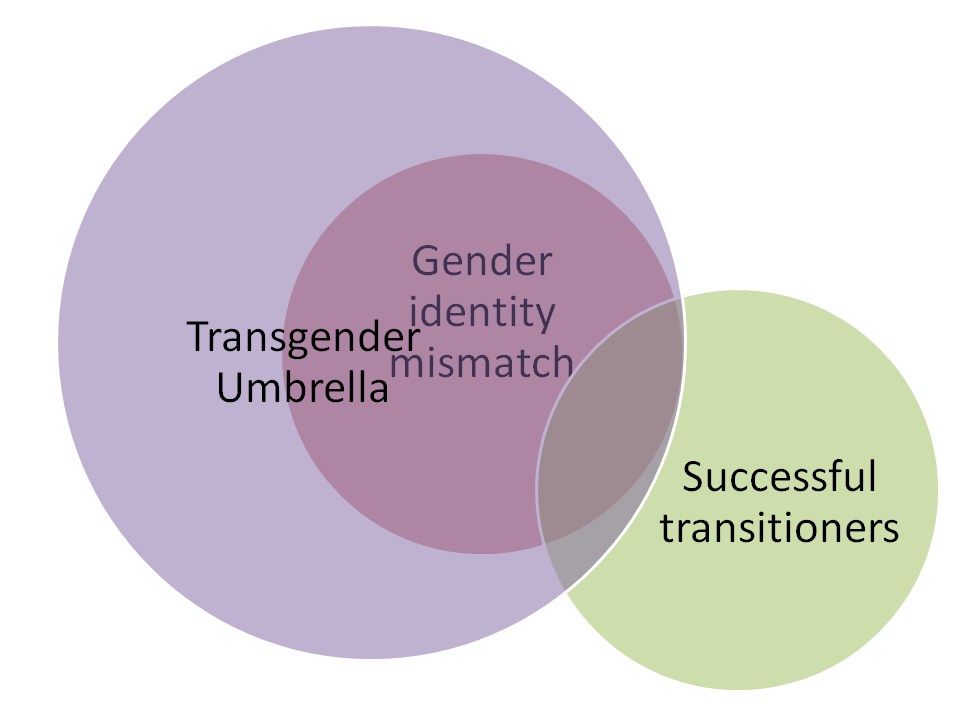
Transgender is the state of one’s gender identity (self-identification as woman, man, neither or both) not matching one’s assigned sex (identification by others as male, female or intersex based on physical/genetic sex). [source]

It is by that definition that I accept and welcome the ‘transgender’ label with open arms.

Makes sense, right? Scott self-identifies as “somewhere in between,” which counts as “neither or both,” and doesn’t match his assigned male sex. But that’s not enough for Monica Roberts:

Roberts’ reaction is really problematic. What bothers me the most is that she is prescribing and delineating appropriate transgender actions. It’s not enough for Scott to appear in heavy makeup, long hair and women’s clothes and shoes every time he is in front of a camera. He has to take hormones, declare a transition, and adopt a name that Roberts approves as feminine enough.
tg definitions1
As I wrote back in April, there are at least three conflicting definitions of transgender. Roberts is saying that in order for her to consider him trans, Scott has to follow her prescriptions.

Another thing that bothers me is that Roberts is not only claiming the right to define transgender, but the right to define the umbrella. The “umbrella” definition of transgender is an inclusive one that brings in drag queens and anyone else who’s remotely gender-variant. As umbrella proponent Jamison Green famously said, “There is NOT one way to be trans.” Many prescriptive trans advocates explicitly reject the umbrella, many (like GLAAD) switch between the umbrella and their prescriptions, but Roberts claims that the umbrella is her prescriptions.

In a subsequent blog post, Roberts clarified that she worried that this identification was purely a legal strategy, and that Scott was only “embracing the transgender umbrella after resisting it for years.” “Until I get and see more evidence that B.Scott’s embrace of the transgender umbrella is genuine, permanent and not just related to this legal case, call me skeptical.”

Roberts knows a lot more about American black culture’s attitudes towards transness than I do, but I would be surprised if a gay black man who grooms himself like a woman and is often perceived as a woman would face very much less discrimination and harassment than a transitioning black trans woman. How often is Scott really able to draw on his male privilege?

Based on her reactions to RuPaul, my guess is that Roberts is worried that with his large following, Scott could emerge as a powerful trans leader and spokesperson without transitioning, eclipsing her own influence and those of other transitioned black trans people like Janet Mock* and Laverne Cox. Personally, I would welcome an influential non-transitioning trans person of any race to the cause. Any creative responses to trans feelings would be a relief from the relentless hormones-surgery-name-change drumbeat put out by Roberts, Mock and other trans spokespeople. And the transition buy-in that Roberts values so much doesn’t stop her from being divisive and exclusionary.

But regardless of whether you trust Scott to be true to the trans community, Roberts’ heavy-handed prescriptivism should alarm not just advocates of transgender inclusivity, but also feminists of all stripes. And her claiming the right to not just define transgender but to take the transgender umbrella away from us is just uncalled for.

(*Update: In this sympathetic interview, Janet Mock makes it clear that she’s not into that kind of boundary policing.)

Everything you really wanted to know about trans people

dogma
A number of my trans friends and non-trans allies have been tweeting and reblogging last week’s BuzzFeed post by Sarah Kasulke and Chris Ritter, “Everything You Always Wanted To Know About Transgender People But Were Afraid To Ask,” with the subtitle, “It’s cool, we know you have questions.”

It’s been a struggle to explain exactly what bothers me so much about that piece. I’ve taken a stab at explaining the general problem with these two pages, A Skeptic’s Trans 101 and Before You Reblog, but I haven’t addressed the BuzzFeed post specifically.

The first problem with Kasulke’s post is that it’s not everything you always wanted to know about trans people but were afraid to ask. It’s just the latest version of the same old trans dogma dressed up as a Q&A. Here are some things she focuses on that are just not burning questions in people’s minds:

  • Should I say “transgender” or “transgendered”?
  • What do all these fancy words you keep using mean?
  • Am I a horrible person for being skeptical of this true inside gender you claim?
  • I haven’t heard nearly enough about hormones from trans people. Please tell me more!
  • There are genders besides boy or girl?
  • Are drag queens transgender?
  • Should I use the pronouns you clearly want to hear, or the ones I want to say?
  • Do people ever get upset when someone calls them “it”?
  • Should I call trans people shemales?

No, the things that everyone always wants to know about trans people are more like this:

  • Are you a man or a woman?
  • So you’re gay?
  • Have you had the surgery?
  • What happens during the surgery?
  • How do you have sex?
  • Are those real?
  • How do you hide it?
  • Why would you do this to yourself?
  • Isn’t there some kind of therapy for this?
  • Can’t you just be a butch lesbian?
  • What does your mom think?
  • What do your kids call you?
  • Is your wife really okay with it?
  • Can I have sex with you? Not because I like you, but just to satisfy my own curiosity and then move on to a real woman?

and yes:

  • What is your real name?

I’m not saying that anyone deserves answers to these questions. But the genius of David Reuben’s original book Everything You Always Wanted to Know About Sex (but Were Afraid to Ask) is that it took a topic where there was so much shame and prudery, chose questions that were actually in people’s minds, and answered them without moralizing. It was a breath of fresh air after the tedium and taboo of what had passed for sex education before.

Kasulke and Ritter’s piece reads more like the books that Reuben was reacting to. It’s full of moralizing, shame and taboo. If someone’s afraid to ask “what’s your real name?” how are they going to feel after reading Ritter’s slide? Despite Kasulke’s subtitle, she clearly doesn’t think it’s cool to have questions like that, and she’s not going to answer them.

I’ll tell you what: I’ll answer your questions. If you read my Skeptic’s Trans 101 and still have questions, poke around on the site a bit. If you still have questions, email me. And if you see a post like Kasulke and Ritter’s, please check my list before you forward it.

Update: Two weeks after I posted this response, Kasulke (now Calvin Kasulke) posted “17 Questions Trans People Are Tired of Hearing.” I don’t know how much BuzzFeed paid him, but I’m still waiting for my cut.

Were you looking at the woman in the red dress?

Film director Lana Wachowski, whom I associate most with the Matrix, has now declared her gender transition. I didn’t feel comfortable speculating when her transgender feelings were just a rumor, but now I can say that I see the Matrix as a deeply transgender movie. Blogger Hannah DuVoix finds a number of trans themes in the movie, but dissociation and glamour are the two that make the biggest impression on me. (There will be some spoilers here for those who haven’t yet seen it.)

The Matrix is dissociative. Dissociation is a psychological term for a particular kind of disconnect from reality, at least as others experience that reality. Dissociation can range from plain old field-independence to a deeply held belief that “my” body is not my own. One of its most extreme expressions is the dissociative fugue, where a person runs away and assumes a new identity, sometimes forgetting who they “really” are.

I refuse to speak for all trans people, but my own trans feelings have always contained an element of dissociation, and I’ve seen and heard it from others. A lot of my trans fantasies have involved some disconnection from my body. When I was younger I used to fantasize about moving to a different city and taking on a completely new identity for myself. Many trans people have done this, including the story of Holly Woodlawn as Lou Reed tells it in “Take a Walk on the Wild Side.”

In the Matrix, these dissociative fantasies are reality. When Neo takes the red pill, his entire reality is revealed to be an illusion, and he discovers his real body and the sensations that go with it. He is not just a programmer, “Mr. Anderson,” in a dreary world. He is something more, something where his “unreal” online identity is foregrounded.

113The_Woman_in_Red-med
The Matrix deals with glamour, and specifically the desire to own and control feminine glamour. After Neo first disconnects from the Matrix, Morpheus takes him into a training program, a sandbox where he can demonstrate how the constructed world works. He is distracted by “the woman in the red dress” (played by Fiona Johnson), who walks by, smirking flirtatiously, and then turns into an evil Agent pointing a gun at Neo.

When Neo leaves the training program, his new shipmate Mouse slyly confides that he created the woman in the red dress, and that she’s available for other encounters. It’s not exactly a secret that many trans people obsess over the glamour of their target gender, trying to discover and replicate its secrets.

In her speech to the Human Rights Campaign, Wachowski talks about spending hours trying on dresses in the wardrobe closet of her high school drama club. I have similar memories, and when I saw the Matrix I had spent the previous year and a half working on my own animated virtual women, one of whom was sort of blonde (and neither of whom turned out anywhere near as sexy as the Woman in the Red Dress). Like Mouse – and Wachowski – I had very good reasons for doing it, but those reasons don’t preclude others.

Again, I’m not saying that all trans people are dissociative or obsessed with the glamour of their target gender, but these are themes we hear from lots of trans people. I wasn’t entirely surprised with the rumors and later revelations about Wachowski, because I had recognized a kindred spirit.

The consequences of sampling bias

I wanted to go into a bit more detail about something I’ve mentioned before: that the use of non-representative samples can cause problems down the line. To illustrate this, I want to examine the claims of health disparities that Emilia Dunham lists in her Bay Windows article.

  1. Transgender people take more hormones and have have more surgeries than average.
  2. Transgender people smoke at a 30% prevalence rate, and use other substances to cope with the stress from discrimination.
  3. We’re more likely to suffer from depression and anxiety, and more likely to live with HIV.
  4. 61 – 64% of transgender people have been physically or sexually assaulted.
  5. 41% of transgender people have attempted suicide.
  6. All these percentages skyrocket for transgender people of color and low-income folks.
  7. A startling 1 in 5 transgender people have experienced complete refusal of services from healthcare providers.
  8. If transgender people aren’t referred to with correct names or pronouns or are treated with coldness, they may avoid the office.

Of these statements, only the last one is an existential statement. All the others are statements of prevalence or likelihood that are not generalizable without a representative sample. In my impression, some of them are more likely to be true of the entire transgender population than others. There are chains of causation from transgender actions to these disparities, and the chains are not all the same. Here are some possible causal chains. They are not the only possible ones, but they are the ones that seem likely to me.

First there are the inherent consequences of transgender actions: more hormones and surgery. If you’re only concerned with transpeople who choose to take hormones and undergo surgery, then of course this is true. But if you believe that not all transpeople choose hormones or surgery, and you don’t know how many do, then you have no way of knowing how great these disparities are.

Then there is harassment based on perceptible differences: physical and sexual assault. A lot of this has to do with passing – as one gender or another, not necessarily the one you prefer. The passing does not have to be total: a transperson can avoid a lot of harassment simply by avoiding being noticed. However, note that there is a feedback loop here regarding socioeconomic status: wealthier transpeople can afford higher quality hormones, surgery, hair removal or attachment, clothes, padding, cosmetics and training that can give them (us) a better chance of passing as the target gender.

There is also discrimination based on records or perceptible differences: refusal of healthcare service. There can also be housing, consumer and job discrimination, which can affect some of the factors below.

A transgender person has a number of potential reactions to the harassment or discrimination described above, including: avoidance of healthcare providers, depression, anxiety, substance abuse, suicide attempts. Out of fear of discovery, many transpeople engage in hidden sexual activities, where there is a greater risk of HIV infection.

Completing the vicious cycle I described above are the consequences of poverty, which may in turn result from discrimination: there is greater likelihood of harassment and discrimination (and the consequences that follow from that harassment and discrimination) and sex work (which increases the likelihood of HIV infection).

I know from personal experience, from friends’ anecdotes and from online reading that these disparities do not affect all transgender people. Some people do not choose hormones, some do not choose surgery. Some never take publicly visible transgender actions, and others pass well enough, so they are never harassed or discriminated against. Some are able to deal with the harassment or discrimination they experience without resorting to depression, anxiety or substance abuse, or attempting suicide (which is not a judgment against those who are unable). Some are able to avoid unprotected sex. Some are wealthy enough to avoid the consequences of poverty.

Here’s the problem with sampling: Dunham and other researchers have no way of knowing for sure whether they’ve oversampled from those who choose hormones and/or surgery; those who take publicly visible transgender actions; those who don’t pass enough of the time to avoid harassment or discrimination; those who already have tendencies towards depression, anxiety, substance abuse, suicide or casual sex, for unrelated reasons; and those who have lower incomes. After all, these are precisely the populations that public health researchers are more likely to come into contact with. Without representative samples, they can never prove that these disparities exist to the extent that they claim.

Now I want you to imagine that these researchers actually have been oversampling these higher-risk populations. On one level the consequences are minimal: if these are the populations with the greatest need, then it’s just another way to spend public health dollars on the people who need them the most. But on the image level and the credibility level, there are problems.

I’ve seen on the Web and on television that some people have a stereotype of “tranny” that combines all these factors: a drug-addicted, unpassable, mentally ill hooker with bad plastic surgery. Some people use that stereotype to justify harassment and discrimination against transgender people, and some family members fight against accepting their relative’s transgender feelings because they fear that this will be their fate. These kinds of unsupported survey results feed into those stereotypes.

What if at some point someone does succeed in doing a representative survey, and finds that the drug-addicted, cigarette-smoking sex workers are a small portion of the transgender population, and that the average transgender person is a drug- and disease-free, well-adjusted, successful computer technician making $60,000 a year? What if all the transgender health money was actually better spent on overlapping programs that would serve the needy population just as well? I think someone might feel cheated, and I think there might be a backlash.

There’s also the possibility that we might be missing out on some valuable information. What if we found that there were people who had the exact same background, and the exact same transgender feelings, but one group became drug-addicted HIV-positive hookers and the other became successful computer technicians? We could examine the populations and see what made the difference between health and sickness. It might not be the obvious solution.

This is why we need representative sampling, and this is why you need to comment on the proposal and tell that to Secretary Sebelius.
Glamor, Horror and the Trans Fatale

A couple of years ago I recommended to you Virginia Postrel for her insightful discussions of glamour, and argued that they’re relevant to transgenderism and transvestism.  Now Postrel has started a new blog focusing on glamour, as part of a new book she’s writing on the subject.  This is definitely good stuff.

Growing out of a discussion of whether a McCain presidential campaign ad aims to present Obama as the Antichrist, Postrel has a great post about the relationship between glamour and horror.  She writes:

While horror comes in different forms, some decidedly unglamorous (e.g., Alien, Saw), a lot of horror, including vampire tales, depends on glamour: What starts out as beautiful and alluring is revealed to be terrible and life-destroying–and by then it’s too late. Witness not only the vampire but the femme fatale, especially in her 19th-century form. Glamour promises escape and transformation; horror replaces escape with entrapment.

(With regard to gross-out “horror” movies like Saw and Friday the 13th, I’d say that they’re more appropriately called “terror movies.”  Sadly, that term has now been appropriated by the terrorism frame, but before that there were some insightful discussions of the contrast between terror and horror.)

This explanation of horror helps me to understand some of the various “trans fatale” movies (Dressed to Kill, Homicidal, M Butterfly): if the idea of the femme fatale plays off of men’s fears of unexpectedly strong women, then the trans fatale has the glamour of being beautiful and alluring, but are even more threatening because they can be imagined to possess the physical strength and aggression (and ability to rape) of men.

Going further, it seems connected to the “trans panic” that some men have claimed: they believed they were kissing a vulnerable woman, and on discovering that the person was male they were overwhelmed with the fear that they had been seduced and would be raped or killed.  This is often, horribly, used to justify beating and even killing the trans person.  Of course, a male who is small or slim enough to pass as a vulnerable woman usually has no more strength than a woman that size, and any trans woman on hormones probably doesn’t have much ability or desire to penetrate a man, but reality plays very little role in any of this.

Deconstructing glamour with reality is actually an effective comedy technique, and this can explain why so many people find cross-dressing funny.  Since men have many of the traits that are considered unattractive in women (hairy, sweaty, big bellies), but more commonly and to a greater degree, a cross-dressed man can produce just enough cues to project the image of a glamorous woman (long wig, long legs, short skirt) before shattering that image with a hairy belly.  The humor is a bit broad for my taste, but it clearly works for many people, as shown by the enduring popularity of Benny Hill and Martin Lawrence.

The first pregnant man?

Sometimes trans dogma can be funny when it paints itself into a corner.  Here’s an example from the current news about Thomas Beatie.  Beatie is a transman who just gave birth to a baby girl.  This Metafilter thread claims that he’s “first legally transgendered man to become pregnant.”  This is just one of the many Bogus Transgender Firsts.

Back in 2004 there was a transwoman who claimed to be the first transgender delegate to the Democratic National Convention.  A little googling revealed that there was a trans Carter delegate in 1976, and possibly a trans delegate to the 1968 convention.  Ever since then I’ve been skeptical about Transgender Firsts.  Some transpeople, despite paying lip service to the idea that transpeople have been around forever, seem to think that history began some time around 1998.

Metafilter user Grapefruitmoon managed to assert the notion that Beatie is the First Pregnant Transgendered Man even while linking to an article in the London Telegraph that contradicted this claim.  A little bit of thought suggests that this Transgender First is highly unlikely.

We know that people have been cross-dressing and cross-living for thousands of years, and expressing feelings that could broadly be considered transgender for about as long.  Many transgender people claim them as spiritual forefathers and foremothers, even though if Henri III were alive today they’d probably bounce him out of the support group for not taking hormones.  If you want to claim that the Abbé de Choisy or Billy Tipton were trans, you’d guess that there have been transmen for as long as there have been men.

In the essentialist point of view, transgenderism begins in the womb, if not in the genes.  Along these lines, if you accept someone as transgender they are eternally transgender, whether they’ve had any body modifications or not.  This is always a source of laughs when people who were “heterosexual cross-dressers” last week all of a sudden become eternally transgender, provoking a desperate flurry of revisionism.  More to the point, if you accept the notion of Eternal Transgenderism, not only was Beatie a man his entire life, but so was everyone who can be corralled into the Transmen Through History exhibit.

Reading through some of the lives of pre-testosterone-injection transmen, it seems that most of them began to live as men quite young.  A cursory search doesn’t turn up any record of any of them having been pregnant, but there are plenty of transmen who are attracted to men, and plenty of others who’ve tried to conform and live as women for part of their lives.  There are also, shamefully, transmen who’ve been raped.  Whether or not it was something he desired or intended, it seems pretty likely that some transman must have become pregnant some time in the past.

I’d even venture to say that Beatie is probably not the first transman married to a woman who can’t bear children.  I could imagine a transman who passed as a man for years, married a woman who knew his secret, and then found himself in a situation like Beatie’s.  I can imagine this transman conceiving a child in one way or another, arranging to go on a trip somewhere with his wife, living as a woman for long enough to deliver a healthy baby, and returning as a happy father and mother.

Just because I can imagine something doesn’t mean it happened, and I don’t know of any documented case of a transman becoming pregnant before Beatie.  Maybe it never happened, but it’s irresponsible to keep claiming “firsts” without making any attempt to actually check whether something is the first.  Beatie was quite likely the first pregnant transgender man to be featured on Oprah, but history was old before Oprah.

Grapefruitmoon could possibly get around this by using the phrase “legally transgendered man.”  But I don’t know of any legal certification for transgenderism.  There’s clinical diagnosis, but I don’t know if Beatie has one.  Beatie has legally changed his gender, but before the era of birth certificates it was possible to do that by simply passing for long enough to establish an identity.

There is a word for what Grapefruitmoon meant: “first known.”  This provides some protection, at least.

Christina Sforza’s experience

Blogger RachelPhilPa linked both to my post about Ian Harvie’s bathroom experience and a YouTube video of Christina Sforza describing her assault by the manager of the McDonalds on Fifth Avenue and 34th Street (which I also reported). The video was taken a year later and nothing has been done. Sforza’s story is very disturbing. I admire her courage for pursuing justice after that kind of treatment.

Last year I emailed the staff of Council Speaker Quinn (the McDonald’s in question is in her district) and got some encouraging responses. This Amnesty International report says that Quinn’s intervention allowed Sforza to file a complaint (it’s not clear whether against the manager or the police officers). However, I have not heard anything since last year. The report also gives contact information for Commissioner Kelly, an advisor to District Attorney Morgenthau and Speaker Quinn.